

How to Find Clothes That Fit Your Body Type
Table of Contents
- Understanding Body Proportions and Silhouette
- How to Measure Body Proportions Accurately
- Identifying Your Body Shape and Proportions
- Choosing Silhouettes That Balance Your Frame
- Wardrobe Essentials for Every Body Type
- How to Find Your Personal Style Within Your Proportions
- The Role of Tailoring and Custom Fit
- Common Fit Mistakes to Avoid
Last Updated: October 1, 2026
Understanding Body Proportions and Silhouette
Finding clothes that fit your body type starts with understanding how your body's proportions work together. Body proportions determine which silhouettes will balance your frame and which will work against it. Rather than forcing yourself into arbitrary size categories, learning your actual proportions gives you the power to shop with intention and confidence.
Your body is made up of vertical and horizontal proportions. Vertical proportion refers to how your body divides from top to bottom, where your waistline sits relative to your hips, where your legs begin, and how your shoulders relate to your overall height. Horizontal proportion is about width: shoulder width, hip width, and how balanced they appear together. When you understand these relationships, you can choose garments that either enhance or minimize certain areas depending on what makes you feel best.
At Rick's by Design, we've helped countless customers understand that fit isn't about conforming to a standard, it's about knowing yourself well enough to make intentional choices. The right silhouette respects your natural proportions and works with your body rather than against it.
How to Measure Body Proportions Accurately
Key Measurements to Track
Start by taking five essential measurements that will guide every shopping decision. You'll need a soft measuring tape and a mirror, and it helps to wear fitted clothing so you can see your actual shape.
Shoulder width: Measure across the widest point of your shoulders, from the outer edge of one shoulder bone to the other. This number tells you whether you have narrow, average, or broad shoulders, critical information when choosing necklines and sleeve styles.
Bust: Measure around the fullest part of your chest, keeping the tape parallel to the ground. This is your baseline for fitted tops and dresses.
Waist: Measure at your natural waistline, the narrowest part of your torso. This is where your body naturally bends when you lean to one side.
Hip: Measure around the fullest part of your hips and buttocks. This measurement matters for pants rise, skirt fit, and whether a garment will skim or cling through the hip area.
Inseam: Measure from your inner thigh down to your ankle bone while standing in bare feet. This determines hemline length and whether pants will need alterations.
Record these measurements and note the proportions between them. If your shoulders are significantly wider than your hips, you have a pear-shaped proportion that benefits from different styling than someone whose hips and shoulders are balanced.
Using Your Measurements to Guide Shopping
Your measurements are your shopping blueprint. Before adding anything to your cart, compare the garment's measurements to your own. Most retailers provide detailed size charts, use them. A size 8 at one brand may fit completely differently than a size 8 elsewhere, so measurements matter far more than the number on the tag.
Pay special attention to the rise of pants and the placement of waistlines on dresses. If your waist is high relative to your hips, a low-rise pant will gap at the back. If your torso is long, a crop top that hits at the natural waist on an average-height model might hit below your waist on you. Your measurements reveal these details before you order.
Identifying Your Body Shape and Proportions
Understanding your body shape helps you predict which styles will flatter your frame. Common body shape categories include hourglass (balanced shoulders and hips with a defined waist), pear (narrower shoulders and wider hips), apple (wider shoulders and midsection with slimmer legs), and rectangle (shoulders and hips roughly equal with less waist definition).
However, body shape is just one piece of the puzzle. Two people with the same "pear" shape might have different shoulder widths, different leg lengths, or different amounts of waist definition. This is why proportions matter more than labels.
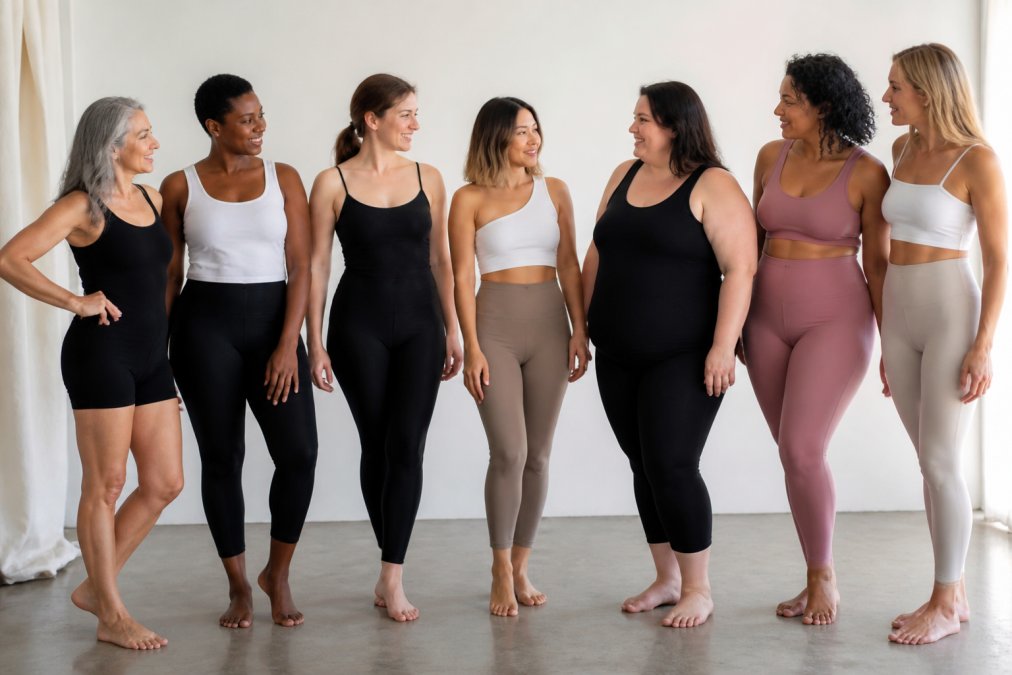
The key insight is this: your body shape describes your silhouette, but your proportions determine which garments will actually work. A pear-shaped person with long legs needs different hemlines than a pear-shaped person with shorter legs. Someone with broad shoulders benefits from different necklines than someone with narrow shoulders, regardless of whether they're both pear-shaped.
Spend time honestly assessing where your body carries weight, where you have curves, where you're straighter, and how your body divides vertically. This self-awareness is the foundation of understanding how to find clothes that fit your body type with intention.
Choosing Silhouettes That Balance Your Frame
The right silhouette works with your proportions rather than against them. A silhouette is the overall outline a garment creates on your body, whether it's fitted, loose, A-line, or structured.
Necklines and Shoulder Details
Your neckline choice either draws attention to or minimizes your shoulders and neck. If you have narrow shoulders, a wide neckline (boat neck, off-shoulder, or wide scoop) creates the illusion of width. If you have broad shoulders, a narrower neckline (V-neck, turtleneck) balances them by directing the eye downward.
Shoulder seams matter too. A seam that sits exactly at your shoulder point creates clean lines. If the seam extends beyond your natural shoulder, the garment pulls and creates bulk. If it falls short, you lose structure. This is where tailoring becomes valuable, a simple adjustment can transform how a garment sits.
The V-Neck Spaghetti Strap Bodysuit from Rick's by Design works beautifully as a foundation piece because the V-neckline elongates and balances broader shoulders while the spaghetti straps keep the look refined. Layer it under blazers for professional polish or pair it with high-waisted jeans for everyday styling.

Waistlines and Rise Placement
Where a waistline or rise sits on your body dramatically changes how a garment flatters you. A natural waistline (at your actual narrowest point) emphasizes an hourglass proportion. A high waistline elongates shorter legs and balances broader hips. A low waistline can work if your hips are narrow, but creates unflattering gaps if your hip-to-waist ratio is significant.
For pants, rise refers to the distance from the crotch seam to the top of the waistband. Low-rise sits below the natural waist. Mid-rise sits at the natural waist. High-rise sits above the natural waist. Your rise preference depends on your proportions and personal comfort, but high-rise generally flatters more body types because it defines the waist and elongates the leg.
The High-Waist Hip-Lifting Yoga Pants and High-Waist Seamless Leggings from Rick's by Design both use high-rise placement specifically because it provides coverage, defines the waistline, and creates a balanced silhouette across different body types.
Hemlines and Vertical Proportion
Your hemline length affects how your proportions appear. A hemline that hits at the widest part of your leg (usually mid-calf) shortens your leg visually. A hemline that hits at your ankle or just above elongates the leg. If you have shorter legs relative to your torso, longer hemlines work better. If you have longer legs, you have more flexibility with where a hemline lands.
Wardrobe Essentials for Every Body Type
Certain pieces work across all body types because they're fundamentally versatile. A well-fitting white button-down adapts to countless occasions and body shapes depending on how you style it. A simple tank or bodysuit serves as a foundation under everything from blazers to cardigans. High-waisted bottoms work across proportions because they define the waistline and elongate the leg.
How to Find Your Personal Style Within Your Proportions
Understanding your proportions doesn't mean you're locked into one aesthetic. Your proportions are the framework; your personal style is how you decorate within it. Someone with a rectangular body shape can wear fitted silhouettes, oversized pieces, or anything in between, the key is understanding which choices work best for their proportions and then choosing the aesthetic they prefer within those parameters.
The Role of Tailoring and Custom Fit
Even perfect proportions sometimes need adjustment. Tailoring transforms a good fit into a perfect fit. A tailor can adjust hemlines, take in seams, adjust rise, taper sleeves, and modify necklines. What matters is understanding which alterations are worth the investment.
Common Fit Mistakes to Avoid
The biggest mistake people make is ignoring proportions and buying based on size alone. A size 8 doesn't mean anything if the rise is wrong, the shoulder seam doesn't align with your shoulders, or the length doesn't work for your proportions. Always check measurements before assuming a size will fit.