

How to Layer Sweaters for a Stylish Winter Capsule
Last Updated: November 4, 2026
Quick Summary
To layer sweaters for a stylish winter capsule, use a three-layer system: a thin, fitted base layer that wicks moisture, a sweater as the mid layer that traps warmth, and an outer shell that blocks wind and rain. Keep the bottom layer thin and only one piece relaxed to avoid bulk.
- Cotton holds moisture against your skin, so choose merino, silk, or synthetic thermals instead.
- Match the base to the knit: silk or ultralight merino under fine-gauge, midweight merino under chunky knits.
- Build the capsule around three or four neutral knits, mixing one chunky sweater with one fine knit.
- Limit yourself to one voluminous piece and keep the innermost layer fitted to control visual weight.
- Wash knits cold, lay flat to dry, fold rather than hang, and wash every three to five wears.
Table of Contents
- The Three-Layer Rule That Makes Sweater Layering Work
- What to Wear Under a Sweater in Winter
- How to Layer Sweaters Without Bulk
- Building a Winter Capsule Wardrobe Around a Few Knit Pieces
- Casual Stylish Winter Outfits for Ladies Who Want Easy Mornings
- Layering for Your Body Type and Personal Style
- Caring for Your Layering Sweaters So They Last for Seasons
- Start Your Capsule With a Sweater You Will Reach For on Repeat
The Three-Layer Rule That Makes Sweater Layering Work
Learning how to layer sweaters for a stylish winter capsule starts with one simple system: three layers, each with a job. Get the system right and you stop guessing every cold morning. Many women buy beautiful sweaters, then wear them badly because nothing underneath is doing its job.
A base layer sits against your skin and manages moisture. A mid layer traps warmth, and this is usually your sweater.
Skip one and the whole outfit fails. Skip the base and you sweat. Skip the shell and the wind cuts straight through your knit.
That is the core idea behind a winter capsule wardrobe. Fewer pieces, better layers, more outfits.
Base, Mid, and Outer: What Each Layer Does
Think of each layer as a role, not a garment.
- Base: thin, fitted, and breathable. It touches your skin.
- Mid: your sweater. It holds warm air close to your body.
- Outer: a coat or cardigan that stops wind and rain.
Once you know the roles, mixing fine knit and chunky sweater pieces gets much easier.
What to Wear Under a Sweater in Winter
The best thing to wear under a sweater in winter is a thin, fitted base layer that moves moisture away from your skin and holds a thin cushion of warm air against your body.
Most women reach for a cotton tee. Cotton absorbs moisture and holds it against your skin, so once you start moving, walking to the train, hauling groceries, chasing a toddler, the fabric gets damp and then chills you.
The Fabric Science Behind a Warm Base Layer
Fabric choice is not a style preference here; it is a performance decision. Each fiber manages heat and moisture differently, and that difference shows up within an hour of wear.
- Merino wool: Fine merino traps air in the crimp of its fibers, which is why it feels warm for its weight. It also absorbs moisture vapor into the fiber core rather than letting it sit on your skin, so it stays comfortable across a wide temperature range. The trade-off is cost and a slightly more careful wash routine.
- Silk: A silk base is the thinnest option that still insulates, which makes it the best invisible layer under a fine-gauge knit or a fitted turtleneck. It is not as durable as wool and offers less warmth when wet, but for office days and indoor-to-outdoor transitions it is hard to beat.
- Synthetic thermals (polyester and polypropylene blends): These wick fast and dry fast, which is why they are common in activewear. They are the most affordable option and the easiest to launder. The trade-off is odor retention over repeated wears and a less breathable feel during long indoor stretches.
The goal is a high warmth-to-weight ratio. A thin layer that wicks beats a thick layer that saturates every time.
REI's guide to layering basics makes the same point: thin, breathable base layers outperform thick ones because they manage moisture rather than just adding mass.
Matching the Base Layer to the Sweater on Top
The base layer should also match the knit it sits under, or the outfit fights itself.
- Under a fine-gauge knit or a fitted turtleneck: choose silk or an ultralight merino. Anything thicker will show ridges through the knit.
- Under a chunky or cable-knit sweater: a midweight merino or a smooth synthetic thermal works because the sweater's bulk hides the texture of the base.
- Under a V-neck: a base layer with a neckline that mirrors the V (or sits low enough to stay hidden) keeps the line clean. A crew-neck base under a deep V creates a visible band that breaks the vertical line.
Watch out: a base layer that is too loose defeats the purpose.
Get the base right and the sweater on top does its job with far less bulk, which is the next problem to solve.
Each base-layer fabric does a different job, so match the fiber to the knit on top.
| Fabric | Best for | Key difference |
|---|---|---|
| Merino wool | Warmth for its weight | Absorbs moisture vapor; costs more, careful wash |
| Silk | Fine-gauge knits and fitted turtlenecks | Thinnest insulating option; less durable than wool |
| Synthetic thermals | Activewear and easy laundering | Wicks and dries fast; retains odor |
| Cotton | Short outings on mild days | Holds moisture instead of moving it |
How to Layer Sweaters Without Bulk
To layer sweaters without bulk, keep the bottom layer thin and the top layer relaxed. Bulk comes from two thick pieces fighting for the same space.
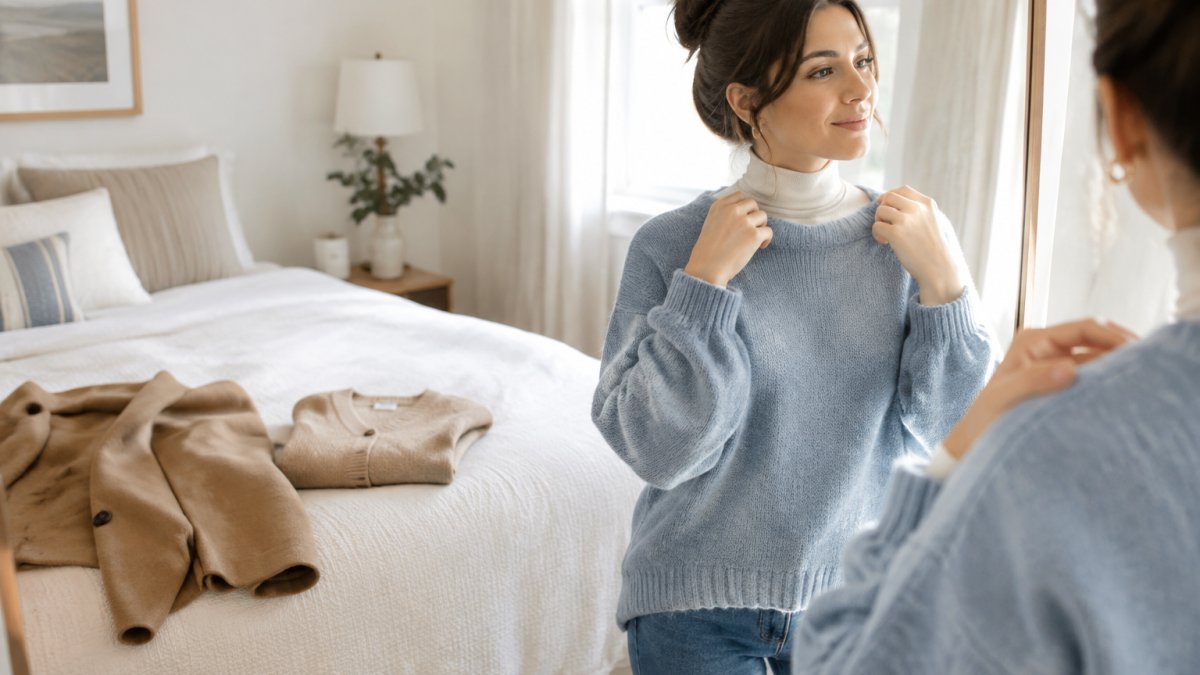
Here is how we would do it:
- Start with a fitted, thin base layer.
- Add a fine knit as your mid layer.
- Choose one relaxed piece on top, never two.
- Tuck the thin knit into high-waist pants to keep the line clean.
- Roll or push sleeves rather than stacking cuffs.
A common mistake is pairing a chunky sweater with a bulky scarf and a puffy coat. Pick one voluminous piece and keep the rest close to the body.
For an easy option, our Lace-Up V-Neck Hooded Knit Sweater | Drop Shoulder Oversized Pullover has a relaxed drop shoulder that layers over a thin knit without adding heaviness.

Building a Winter Capsule Wardrobe Around a Few Knit Pieces
A winter capsule wardrobe is a small set of pieces that all work together.
The Love to Know guide to capsule wardrobes describes the same approach: fewer pieces, chosen so every item pairs with the rest.
If you are new to the idea, our guide to the benefits of capsule wardrobes explains why less really does work before you commit.
Mixing Fine Knits and Chunky Sweaters for Balance
Balance is everything here. One chunky sweater plus one fine knit covers most days.
- Wear the fine knit under a coat or blazer.
- Wear the chunky sweater as your outer layer indoors.
- Keep colors in the same family so mixing is effortless.
Our Ribbed Knit Pullover Sweater is a good anchor piece. The medium-weight ribbed knit adds texture without heaviness, and the straight cut flatters most body types.

Casual Stylish Winter Outfits for Ladies Who Want Easy Mornings
Casual stylish winter outfits for ladies come down to a simple formula: one knit, one bottom, one layer, one shoe. Decide the formula once and mornings take minutes.
Try these combinations:
- Fine turtleneck + straight jeans + long cardigan + boots
- Chunky sweater + leggings + tall boots + scarf
- V-neck knit over a collared shirt + tailored pants + loafers
Keep a neutral palette so everything matches without thought. Texture mixing does the styling work for you.
Layering for Your Body Type and Personal Style
Layering should flatter your shape, not bury it. The principle is simple: place volume where you want the eye to go, and keep the rest of the outfit close to the body. Most layering guides stop at that sentence. The useful part is the mechanism, why each move works and how to execute it without adding visual weight.
Why Layering Adds Visual Weight, and How to Control It
Every layer adds two things: physical thickness and a horizontal line where it ends. Bulk comes from stacking thick pieces, but visual weight comes from where those horizontal lines land. A hem that stops at the widest part of the hip draws the eye there; a hem that skims past it creates a longer vertical line. That is the lever you control.
- Keep the innermost layer fitted. A thin, close base layer adds warmth without adding a silhouette.
- Limit yourself to one voluminous piece. If the sweater is oversized, keep the bottom slim and the outer layer streamlined.
- Use vertical lines deliberately. An open cardigan, a longline vest, or a deep V-neck all create a vertical channel that reads as length rather than width.
Body-Type Specific Layering Moves
- Pear shape (weight carried through hips and thighs): keep the bottom fitted and add volume on top. A structured or slightly oversized sweater balances the lower body, and a hem that ends above the widest part of the hip keeps the line long. Avoid long, clingy knits that trace the hip.
- Apple shape (weight carried through the midsection): choose a longer, open cardigan or a draped layer that creates a vertical line down the center of the body. A V-neck knit under an open layer draws the eye up and inward. Avoid thick ribbed bands that sit right at the waist.
- Hourglass: tuck fine knits to show the waist, or choose a wrap or belted style that follows your natural line. A chunky sweater worn untucked hides the shape you already have.
A cape-style piece drapes instead of clinging, which flatters many shapes because it skims rather than traces. Our Women's Gray Turtleneck Cape-Style Batwing Sweater does exactly that.

Personal Style Without Starting Over
Body type is only half the equation. Personal style decides which of these moves you will actually wear.
- Minimalist: stick to two tonal layers, a fine knit and a relaxed outer knit in the same family, and let texture do the work.
- Classic: layer a fine turtleneck under a collared shirt under a crew-neck sweater, and keep the palette neutral.
- Creative or maximalist: use one patterned or textured layer against solid bases so the eye has one place to land.
Watch out: the most common body-type mistake is sizing up to "hide" an area. An oversized layer over a fitted one reads as intentional; two oversized layers read as bulk. Keep one variable loose at a time.
Caring for Your Layering Sweaters So They Last for Seasons
A capsule only works if the pieces survive. Care is the quiet hero of a long-lasting wardrobe.
- Wash knits cold and on a gentle cycle.
- Skip the dryer; lay sweaters flat to dry.
- Fold, never hang, to keep shoulders in shape.
A common mistake is washing after every wear. Most sweaters need a wash every three to five wears.
Start Your Capsule With a Sweater You Will Reach For on Repeat
The best capsule starts with one sweater you actually love wearing. Get that piece right and the rest of the wardrobe builds itself around it.
A relaxed V-neck earns its place because it works over a collared shirt, under a coat, and on its own. Our Women's Relaxed V-Neck Drop-Shoulder Pullover Sweater fits that brief: soft, easy, and quietly polished, with a flattering neckline and ribbed cuffs that keep the finish neat.
Ready to plan the rest? Our capsule wardrobe budget guide walks you through building the full set without overspending.
Building a winter capsule takes a little planning, but the payoff is real: easy mornings, fewer decisions, and outfits that feel good every time. At Rick's by Design, we curate stylish, on-trend pieces designed to help every woman look and feel her best, with budget-friendly options and a focus on confidence. Explore our collection of knits and layering staples, and get started with Rick's by Design to build a wardrobe you will reach for on repeat.
