

How to Find Comfortable Walking Shoes for Travel in 2026
Quick Summary
Learning how to find comfortable walking shoes for travel comes down to fit, cushioning, arch support, and materials. Choose a roomy toe box with a stable heel, a springy midsole, a removable footbed, and a breathable upper, then break the shoes in over two to three weeks before you pack them.
- Fit matters most: toes need room to spread and the heel should stay anchored.
- Try shoes on at the end of the day, when feet are slightly swollen.
- Choose a removable footbed so you can add an orthotic if needed.
- Match the weather treatment to the wettest conditions you realistically expect.
- Break in new shoes over two to three weeks, increasing walk length gradually.
Table of Contents
- How to Find Comfortable Walking Shoes for Travel in 2026
- What Makes a Walking Shoe Comfortable for Travel
- Best Women's Walking Shoes for Travel With Arch Support
- Choosing Shoes for City Walking, Light Hiking and Airport Security
- Materials, Breathability and Weather Resistance
- How to Break In New Travel Shoes Before You Leave
- Travel Shoe Packing Tips and Rotation for Multi-Week Trips
- Booking Your Next Pair for the Trip Ahead
How to Find Comfortable Walking Shoes for Travel in 2026
Last Updated: November 4, 2026
What Makes a Walking Shoe Comfortable for Travel
Learning how to find comfortable walking shoes for travel comes down to fit, cushioning, and how well a shoe handles hours of movement on unfamiliar ground. Most travel regret starts with a shoe that looked good in the store but caused blisters by the second day in a new city.
We recommend judging each candidate on a few core traits before you buy. Start with fit and stability, then look at cushioning, weight, and breathability. A shoe that scores well on all four will carry you through a multi-week trip.
Fit, Toe Box and Heel Stability
Fit matters more than any other feature. Your toes should have room to spread, and your heel should stay anchored without slipping on each step. A roomy toe box reduces pressure on the forefoot, which is where fatigue tends to build on long walking days.
Try shoes on at the end of the day, when feet are slightly swollen, and walk around the store for several minutes. Watch for rubbing at the heel or pinching across the sides. Choose a style that feels secure, not tight.
Cushioning and Shock Absorption
Cushioning absorbs impact from every step, which adds up quickly over a full day of walking. Look for a midsole that feels springy rather than hard, and check that the sole has enough give to flex naturally where your foot bends. Too much softness can reduce stability, so balance comfort with support.
Our Women's Lightweight Breathable Running Shoes offer a lightweight, breathable running-style option for travelers who spend long days on their feet. Browse them here: Women's Lightweight Breathable Running Shoes

Best Women's Walking Shoes for Travel With Arch Support
Arch support is the feature travelers most often overlook, and it is the one that prevents the deepest foot fatigue.
When comparing options, check whether the insole is removable. A removable footbed lets you swap in an over-the-counter orthotic if your feet need extra support. Many shoppers find that a firm heel counter plus a contoured footbed gives the most reliable comfort.
Choosing Shoes for City Walking, Light Hiking and Airport Security
Your itinerary should shape your shoe choice. City walking calls for a shoe with a flexible sole and a breathable upper. Light hiking requires more traction and a slightly firmer heel.
Slip-on styles speed up security lines, while lace-up shoes give more control on uneven ground. Explore them here: Women's Lace-Up Side-Zip Sneakers

For a breathable everyday style that moves easily from street to sightseeing, see our Women's Breathable Mesh High Heel Shoes: Women's Breathable Mesh High Heel Shoes
Materials, Breathability and Weather Resistance
Materials affect how your feet feel over a long day, not just in the first hour. The upper controls heat and moisture escape, the lining controls friction against the skin, and the treatment on the outside controls how much water gets in. Judge each layer separately before you buy.
Breathability: How Moisture Actually Escapes
A breathable upper moves water vapor from the inside of the shoe to the outside. Engineered mesh and knit uppers do this best because they have open structure between the fibers, so hot air and sweat vapor pass through instead of condensing against your sock.
Look for a mesh or knit upper with a thin, smooth lining. A padded collar and tongue add comfort but also trap heat, so balance padding against ventilation. If you run hot, prioritize an open mesh over a heavily padded knit.
Weather Resistance: Membranes, Coatings and Trade-Offs
Water resistance comes in three main forms, and each behaves differently on a trip.
- Waterproof membranes. A thin membrane bonded inside the upper blocks liquid water while (in theory) letting vapor pass. These keep feet dry in sustained rain, but they also reduce breathability, so feet run warmer. They work best in cool, wet climates and are overkill for hot, dry destinations.
- Durable water-repellent (DWR) coatings. A surface treatment that makes water bead and roll off. It handles light rain and puddle splashes, but it wears off with abrasion and needs reapplication. DWR does not compromise breathability the way a membrane does.
- Untreated canvas and mesh. These soak through quickly in heavy rain. Canvas dries slowly and holds water against the foot, which is the worst combination for a long walking day.
A practical rule: match the shoe to the wettest weather you realistically expect, not the worst-case forecast. A DWR-treated mesh shoe is the better choice for a mostly dry trip with occasional showers, while a membrane shoe earns its place on a cold-weather or rainy-season itinerary.
Drying Speed and Odor
Synthetic mesh and knit dry faster than leather or canvas, which matters if you get caught in rain or sweat heavily. Fast-drying uppers also reduce odor because bacteria need moisture to multiply.
Our Women's Lace-Up Canvas Sneakers use a durable 100% polyester canvas upper.
The article breaks down how each material and weather treatment affects comfort on a long travel day.
| Feature | Behavior on a long day | Best for |
|---|---|---|
| Engineered mesh or knit upper | Moves vapor out, dries fast | Hot, dry or mixed trips |
| Leather upper | Breathes slowly if unlined | Cooler climates, durability |
| Canvas upper | Dries slowly, holds water | Dry, mild weather |
| Waterproof membrane | Blocks liquid water, runs warmer | Cool, wet climates |
| DWR coating | Sheds light rain, needs reapplication | Mostly dry trips with showers |
| Untreated mesh or canvas | Soaks through in heavy rain | Little or no rain |
How to Break In New Travel Shoes Before You Leave
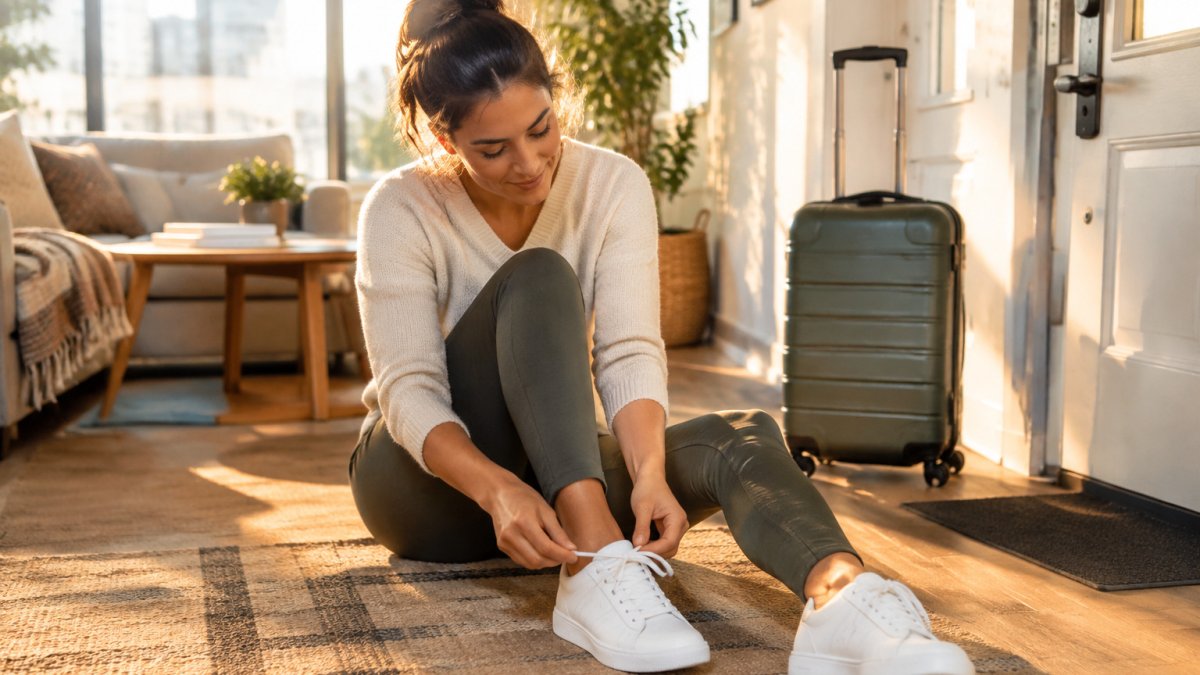
Never pack shoes you have not worn. A new pair can rub in places that feel fine in the store. Breaking in is not just about softening the shoe; it is about letting your foot and the shoe adapt to each other under gradually increasing load, so the spots that would blister show up at home instead of on a cobblestone street.
Why Blisters Form (and What Break-In Actually Does)
Most friction blisters come from three things happening together: repeated rubbing, moisture, and heat. Break-in reduces all three. It softens stiff seams and heel counters so they conform to your foot shape, it compresses the footbed where your foot presses hardest, and it teaches you where the shoe rubs so you can address it before a trip.
A Graduated Break-In Plan
Plan at least two to three weeks, and longer for leather or any shoe with a firm heel counter. Increase distance gradually rather than jumping to long walks.
- Days 1-3: Wear the shoes around the house for 20 to 30 minutes at a time. This softens the upper without exposing you to long friction.
- Days 4-7: Take short errands and 30- to 45-minute walks. Wear the socks you plan to travel in, since sock thickness changes fit.
- Week 2: Build to 60- to 90-minute walks, ideally on pavement and at least once on an uneven surface such as a park path or gravel trail.
- Week 3: Do one or two longer walks that match a typical travel day, and wear the shoes with the exact socks and any insoles you will pack.
Leather Versus Synthetic: Different Timelines
Leather uppers stretch and mold to the foot over time, so they need the longest break-in and benefit most from gradual wear. Synthetic mesh and knit uppers break in quickly because they are already flexible, but they do not stretch much, so fit problems will not resolve themselves, if a synthetic shoe pinches in the store, it will likely still pinch on the trip. Canvas sits in between: it softens with wear but offers little structure.
Handling Hot Spots Before They Become Blisters
Treat any rub the moment you feel warmth or pressure. Apply blister tape or moleskin to the spot on your foot, not just the shoe, and re-check after each walk.
Watch out: do not break in new shoes on back-to-back long days. Give your feet a rest day between long walks so hot spots can settle and you can tell whether a rub is improving or getting worse.
Foot Health for High-Step Travel Days
Long travel days can involve a great deal of walking, and that load exposes weaknesses a short walk hides. Arch support and a firm heel counter are commonly associated with reduced strain on the plantar fascia, the band of tissue along the bottom of the foot that is a common source of heel pain. If you are prone to plantar fasciitis, break in the shoes with any orthotic you plan to use already in place, and test them on a hard surface rather than carpet, since hard surfaces reveal cushioning problems faster.
Travel Shoe Packing Tips and Rotation for Multi-Week Trips
Shoes take up more luggage space than almost anything else, so pack strategically. Two pairs cover most trips: one comfortable walking shoe for daily exploring and one lighter option for evenings or rainy days.
Rotating between two pairs also helps your feet. Alternating shoes gives the cushioning time to recover between wears, which keeps the midsole supportive for longer. On a multi-week trip, this rotation can extend the useful life of both pairs.
Booking Your Next Pair for the Trip Ahead
Choosing the right pair before a trip takes some planning, but the payoff is walking comfortably from the first morning to the last. Use the fit, cushioning, arch support, and materials guidelines above to shortlist two or three options, then break them in before you go.
If the fit is wrong once your shoes arrive, a return should not stop you from getting the right pair. You can read our guide to returning clothes online and compare it with your options before you buy: How to Return Clothes Online Easily
