

7 Steps to Choose the Perfect Capsule Wardrobe Dress
Quick Summary
To choose the perfect capsule wardrobe dress, start by listing the occasions it must cover, then compare silhouettes, check fabric and care labels, and test fit with the layers you plan to wear. Aim for a dress that handles most of your real occasions and works with the blazers and shoes you already own. Keeping your core count to two to four dresses keeps the capsule focused.
- List three columns of occasions: daytime, transitional, and evening.
- Shirt dresses, midi A-lines, and ribbed knits are the three main silhouette families to compare.
- Care labels signal durability; machine wash cold and tumble dry low suggests a dress built for regular wear.
- Test fit with the heaviest layer you plan to wear, then raise your arms and sit down.
- Most people need two to four well-chosen dresses to cover their full range of occasions.
Table of Contents
- Why One Well-Chosen Dress Anchors a Capsule Wardrobe
- Step 1: Define the Occasions Your Dress Must Cover
- Step 2: Compare Dress Silhouettes and Their Pros and Cons
- Step 3: Choose Fabrics That Earn Their Place in the Closet
- Step 4: Test Fit, Sizing, and Room for Layers
- Step 5: Build Your Core Dress Count on a Budget
- Pairing Your Dress With Essential Pieces in a Capsule Wardrobe
- Your Next Step: Shortlist Two Dresses and Try Them With Your Existing Pieces
- Frequently Asked Questions
Why One Well-Chosen Dress Anchors a Capsule Wardrobe
Last Updated: November 12, 2026
A capsule wardrobe works best when every piece earns its place, and a well-chosen capsule wardrobe dress does more of that work than almost anything else in the closet.
A single dress that works for the office, a weekend lunch, and an evening out saves you from guessing each morning and reduces decision fatigue.
This guide walks through seven steps to choose the right capsule wardrobe dress for your life, your body, and your budget, so you can work through it with your own calendar and closet in front of you.
Step 1: Define the Occasions Your Dress Must Cover
Before you look at a single style, list the places you will actually wear the dress. Be specific.
Write down three columns: daytime, transitional, and evening. Most people find two or three occasions cover most of their week, and a dress that works across those is the strongest capsule choice.
The goal is coverage, not perfection. A dress that handles seven out of ten of your real occasions will serve you better than a dress that shines at one and fails at the rest.
Step 2: Compare Dress Silhouettes and Their Pros and Cons
Silhouette is the shape a dress makes on the body, and it decides how easily the dress moves from one setting to another. Three families cover most capsule needs.

Shirt dresses and button-front styles
Shirt dresses offer a tailored, polished look that reads as professional. They layer well under a cardigan or blazer and dress down easily with flat shoes.
- Pros: Strong for the office, easy to belt, and familiar in fit.
- Cons: Less forgiving if the button placement or waist does not suit your shape.
A button-front midi like the Womens V Neck Button Front Midi Dress shows how a simple button placket can move a dress from casual to polished depending on what you pair it with.

Midi and maxi A-line silhouettes
A-line dresses skim the body and flare toward the hem. They suit many figures and feel easy to move in.
- Pros: Flattering across many body types, comfortable for long days, and versatile for both daytime and evening.
- Cons: Longer lengths can overwhelm very petite frames without the right shoe.
Ribbed knit and fitted styles
Knit dresses bring stretch and structure, and they tend to hold their shape through travel and repeated wear. A slim-fit ribbed knit midi with lantern sleeves shows how this fabric looks in a fitted cut.

- Pros: Easy to pack, comfortable, and quick to dress up with accessories.
- Cons: Close-fitting cuts show every fit issue, so check the fit carefully.
Step 3: Choose Fabrics That Earn Their Place in the Closet
Fabric is the biggest predictor of whether a capsule dress survives years of wear or fades into the back of the closet after a season. This section focuses on the specific fibers, weaves, and construction details that determine how a dress ages, and how to inspect them before you buy.
Know the fiber families and how they age
Most capsule dresses fall into a handful of fiber families, and each behaves differently under repeated wear, washing, and packing.
-
Cotton and cotton blends. Breathable and easy to launder, but prone to wrinkling and fading.
-
Viscose, modal, and lyocell. These drape well and feel cool, making them popular for midi and maxi silhouettes. They are weaker when wet, so check the care label.
-
Polyester and polyester blends. Durable, wrinkle-resistant, and colorfast, which is why they dominate travel-friendly knit dresses. The trade-off is breathability, look for moisture-wicking or brushed finishes if you run warm.
-
Ribbed knits. The rib structure provides stretch and recovery, so a ribbed knit often holds its shape well.
Read the care label as a durability signal
A care label tells you how the maker expects the fabric to behave. Machine wash cold and tumble dry low usually signals a dress built to be worn hard; dry clean only signals delicate fibers or construction that will not survive home laundering, meaning higher maintenance and more chances the dress sits unworn.
Watch out: a "dry clean recommended" label on a knit often means the fabric will pill or lose shape in a home washer, so factor that into how often you will realistically wear it.
Inspect seams, hems, and closures before you commit
Fabric quality is only half the story; construction determines whether the dress holds together. Run these checks in the product photos or on the garment itself:
-
Seam finish. Look for finished seams rather than raw edges.
-
Stitch density. Dense, even stitching resists pulling at the waist, armholes, and center-back seam.
-
Hem allowance. A deeper hem gives room to let down or re-hem, extending wearable life.
-
Lining. A lined bodice or skirt reduces see-through issues and helps drape, but adds warmth, relevant for summer wear.
Match fabric to your climate and laundry habits
A fabric that suits a humid summer commute will not suit a cold-weather office. If you layer heavily, choose a smooth, low-bulk fabric that slides under a blazer rather than a chunky knit that bunches at the shoulders.
Be honest about your laundry routine, since a dress you can wash at home is easier to keep in regular rotation.
For a dress that puts these principles to work, the Womens V Neck Button Front Midi Dress shows how a button placket and a considered fabric choice can move a single dress from casual to polished across the week.
The table below sums up how the main fabric families behave, so you can scan them before you buy.
| Fabric | Strength | Trade-off |
|---|---|---|
| Cotton and blends | Breathable, easy to launder | Wrinkles and fades |
| Viscose, modal, lyocell | Drapes well, feels cool | Weaker when wet |
| Polyester and blends | Durable, wrinkle-resistant, colorfast | Less breathable |
| Ribbed knits | Stretch and recovery | Can pill if dry clean only |
Step 4: Test Fit, Sizing, and Room for Layers
Fit is where most capsule dress decisions succeed or fail. The sections below break fit into the specific measurements and construction points that determine whether a dress looks intentional alone and still works under a blazer, cardigan, or coat.
Measure yourself, then compare to the garment, not the size label
Sizing varies between brands and even between styles within a brand, so treat the size label as a starting point and the garment measurements as the truth.
Pay particular attention to waist position. A defined waist seam that sits above or below your natural waist will look off no matter how well the bust fits, so check where that seam falls relative to your own torso length.
Check the four fit points that matter most
Most fit problems trace back to four areas. Inspect each one:
- Shoulders. The shoulder seam should sit at or just past the edge of your shoulder bone. A seam that drops too far reads as oversized; one that pulls inward restricts movement.
- Armholes and sleeves. On sleeveless styles, the armhole should sit close without cutting into the armpit. On long-sleeve styles, check that the sleeve reaches your wrist bone and the upper arm has room to bend.
- Bust and button placket. On button-front dresses, the placket should lie flat without gaping. If it gapes at the bust, size up or look for a hidden placket or looser cut.
Plan for layers before you buy
A capsule dress rarely lives alone. If you plan to wear a blazer, cardigan, or coat over it, the dress needs to accommodate that layer without bunching at the shoulders or pulling across the back.
- Sleeveless and short-sleeve styles layer most easily under a blazer because there is no sleeve bulk to fight the jacket sleeve.
- Long-sleeve knits work under a roomy cardigan but can feel tight under a structured blazer; check that the blazer armhole accommodates the knit sleeve.
- Button-front shirt dresses can be worn open as a light layer over a tee or tank, extending their seasonal range.
A practical test: try the dress on with the heaviest layer you plan to wear over it, then raise your arms and sit down. For a sleeveless knit to check against this test, see the contrast stripe knit midi dress, which comes in a range of sizes.
Watch out: a dress that fits perfectly on its own can feel restrictive once a blazer goes on top, so always test the layered combination rather than the dress alone.
Account for fabric behavior in fit
Fabric changes how a dress fits over time. Knits stretch with wear and recover after washing; wovens hold their shape but have less give. A ribbed knit that feels snug on the first try often relaxes slightly after a few wears, while a woven shirt dress stays close to its original fit.
The sleeveless V-Neck Asymmetrical Button Midi Dress is a good example of a sleeveless style that suits warmer weather.
Step 5: Build Your Core Dress Count on a Budget
A capsule does not require a closet full of dresses. For most people, two to four well-chosen dresses cover the full range of occasions.
Budget with intention. Spend more on the dress you will wear most and be flexible on occasional pieces.
Keep the count small. Every additional dress should fill a clear gap, or it is clutter in a capsule.
Pairing Your Dress With Essential Pieces in a Capsule Wardrobe
A capsule dress becomes a complete system when it pairs with the right supporting pieces.
Shoes and bags do much of the styling work. Flat sandals or loafers keep a dress casual, while heeled boots or pointed-toe pumps bring it up for an evening.
For more ideas on shoes that pair with your dress, see our Affordable Footwear Capsule: 7 Pairs That Cover Everything guide.
Your Next Step: Shortlist Two Dresses and Try Them With Your Existing Pieces
You now have a clear process: define your occasions, compare silhouettes, check fabric, test fit, and keep your core count small. The fastest way to act is to shortlist two dresses that cover your most common occasions, then try each with the blazers, cardigans, and shoes already in your closet before you decide.
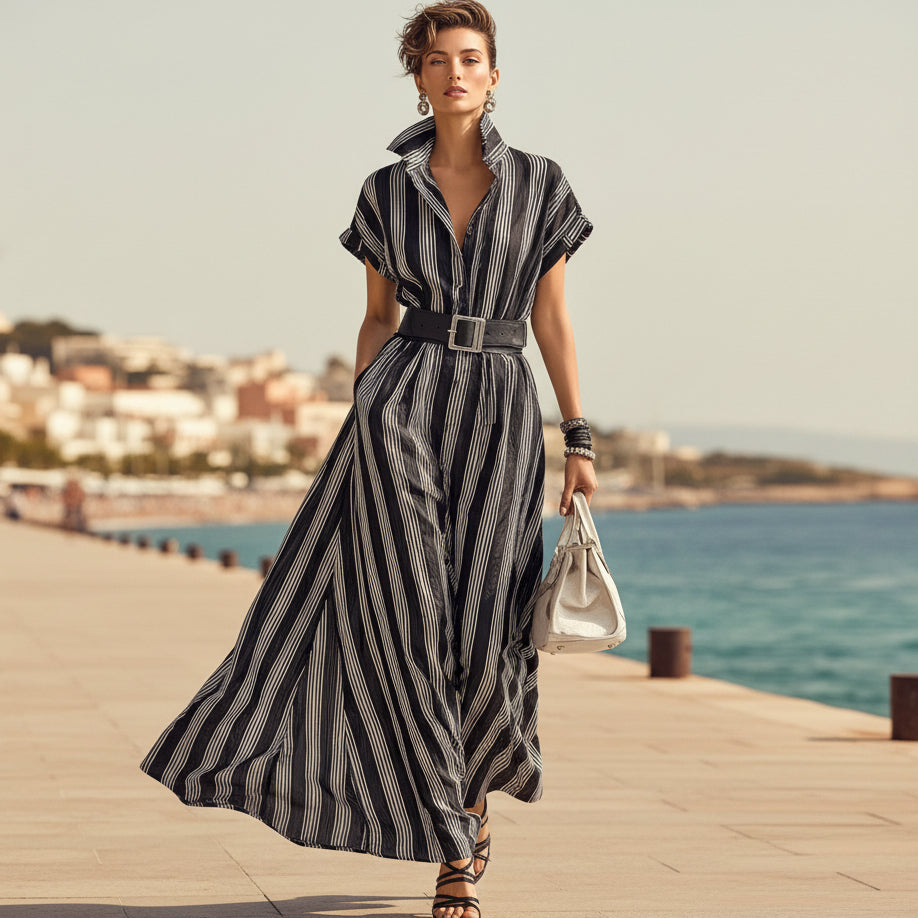
Browse the Women's Striped Long Sleeve Button-Up High Waist Flared Maxi Shirt Dress and the Women's Slim-Fit Ribbed Knit Midi Dress to see how two very different silhouettes can anchor a capsule.
Frequently Asked Questions
How many dresses should be in a capsule wardrobe?
Most people who build a capsule wardrobe keep between three and six dresses, depending on how often they dress up and how many seasons they cover. Start with two or three versatile dresses that cover your main occasions, such as a work-appropriate shirt dress, an everyday midi, and one dressier option. Add more only when a gap appears in your routine. Each dress should pair with at least three of your tops, bottoms, or layers, so every piece earns its place and the wardrobe stays easy to plan.
What dress styles are easiest to wear across seasons?
Midi and maxi dresses in long sleeves work well across seasons because you can layer them with a jacket or cardigan in cooler months and wear them with sandals or a lighter layer in warmer weather. Shirt dresses with a button front are also flexible, since you can wear them buttoned for a polished look or open over a slip dress or shorts. Choose fabrics with some weight and structure for cooler seasons, and lighter fabrics for warm ones, so one silhouette covers the full year.
How do you choose a dress that flatters your body shape?
Start by noticing which silhouettes you already reach for and which make you feel most comfortable. A-line and slim-fit styles with a defined or intentional waist tend to suit a wide range of body shapes, while relaxed loose-waist styles offer comfort without clinging. Check the length and the sleeve shape as well, since these change how the dress sits on your frame. If possible, try the dress with the shoes and layers you plan to wear, because the overall proportion matters more than any single feature.
What fabrics are best for a versatile everyday dress?
Look for fabrics with some stretch or drape, such as polyester blends, ribbed knits, and soft cotton blends, because they hold their shape, move well, and need less pressing. Polyester blends are generally easy to care for and resist wrinkles, which helps when you travel or dress for busy days. Cotton blends breathe well in warm weather. Check the care label before buying and choose fabrics you can wash at home, so the dress stays in rotation for seasons rather than requiring frequent dry cleaning.