

Best Investment Pieces for a Timeless Wardrobe
Table of Contents
- Why Investment Pieces Beat a Closet Full of Trends
- The Timeless Wardrobe Essentials Worth Buying First
- Capsule Wardrobe Essentials: How Many Pieces You Actually Need
- How to Build a Capsule Wardrobe on a Budget
- How to Judge Quality Before You Spend
- Sustainable Wardrobe Tips That Stretch Every Purchase
- Cost Per Wear: The Math That Settles the Decision
- Conclusion
Last Updated: October 20, 2026
Why Investment Pieces Beat a Closet Full of Trends
A timeless wardrobe is a small collection of well-chosen garments that stay wearable across seasons and years, chosen for fit, fabric, and versatility rather than novelty.
The math favors buying well.
Below, we break down which pieces earn their place, how to judge quality, and how to plan a wardrobe budget that stretches further than you expect.
The Timeless Wardrobe Essentials Worth Buying First
Start with the layers that do the most work, the pieces that pull double duty across work, weekends, and evenings, so they justify their cost fastest. Build outward from here rather than buying a dozen random items at once.
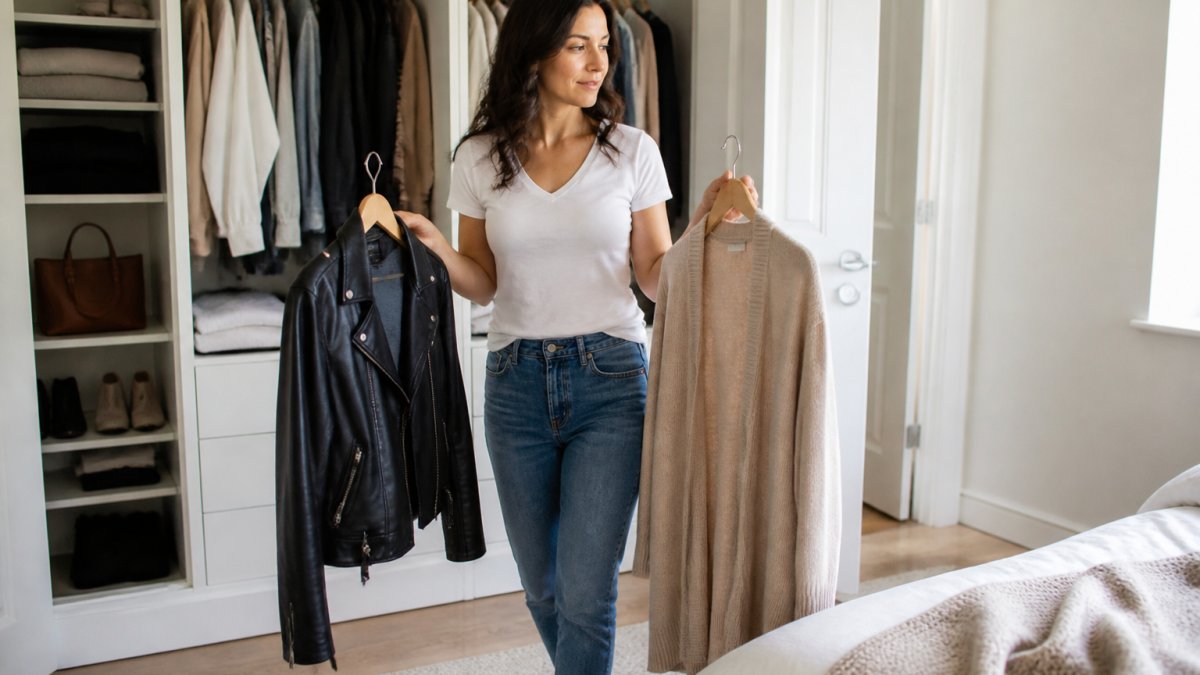
A woman in her thirties standing in a bright bedroom in front of an open closet, holding a black leather jacket over one arm and a long knit cardigan over the other, considering her choice
The Outer Layer: Leather Jacket, Trench, and Blazer
Outerwear is where quality shows first, because it's the layer everyone sees. Our Women's Classic Leather Jacket has a tailored silhouette that moves from day to evening, with functional side pockets and a choice of leather-look or genuine leather finishes. The Women's Classic Lapel Blazer rounds out the trio and holds a structured shape wear after wear.


The Base Layer: Knitwear, Blouses, and Basic Tops
Base layers get the most skin time, so comfort matters as much as looks. A solid V-neck knit works over a collared shirt or alone with jeans. A cotton-linen button-front blouse wears closed as a top or open as a light layer. A long button-front cardigan makes simple separates look intentional.
The Bottom Half and the Finishing Accessories
One great pair of pants and one dress cover most of the calendar. High-waisted wide-leg denim gives you a defined waist and a relaxed leg that reads polished with a blouse and easy with a tee. A V-neck button-front midi dress moves from desk to dinner. Small gold huggies and a chunky wedge pump finish the outfit without demanding attention.

High-Waisted Wide-Leg Denim Pants
Capsule Wardrobe Essentials: How Many Pieces You Actually Need
A working capsule wardrobe essentials list runs about 20 to 30 pieces total, including shoes and accessories. That sounds sparse until you count the combinations: five tops, three bottoms, two dresses, and three layers produce well over 40 distinct outfits.
Category |
Pieces |
What to Include |
|---|---|---|
Outer layers |
3 |
Leather jacket, trench, blazer |
Knitwear and tops |
5 |
V-neck sweater, cardigan, two blouses, basic tee |
Bottoms |
3 |
Wide-leg denim, tailored trousers, skirt |
Dresses |
2 |
Midi day dress, dressier option |
Shoes |
3 |
Wedge pumps, flats, boots |
Accessories |
3 |
Huggie earrings, leather bag, wristwatch |
Most women overbuy tops and underbuy layers. Layers are what make an outfit look finished, so weight your budget there.
How to Build a Capsule Wardrobe on a Budget
Most budget capsule advice stops at "buy less." That's not a plan. A real budget plan separates the categories where spending more pays you back from those where a modest piece performs just as well, then sequences purchases so each one unlocks more outfits than the last.
Separate splurge categories from save categories
The categories that reward spending are the ones you wear hardest and wash least: outerwear, shoes, and structured tailoring.
The categories where a modest piece is fine: basic tees, tanks, and lightweight layering knits. These get washed constantly, so their lifespan is limited by laundry rather than construction.
A workable split most stylists land on: roughly half of a season's clothing budget toward outerwear and shoes, a third toward bottoms and dresses, and the remainder toward tops and accessories.
Use cost per wear to rank the order
Before buying anything, estimate wears per month honestly, multiply by the months you'll wear it in your climate, and divide the price by that total. Rank your planned purchases by cost per wear, lowest first, and buy in that order.
A simple test: if you can't picture at least 20 wears, it isn't a budget purchase, it's a gamble. That filter eliminates most impulse buys.
A three-tier plan that works at any budget
- Tier 1, Foundation (buy first). One outer layer suited to your climate, one bottom that fits at the waist and holds its shape, and one pair of shoes you can walk in all day. These three pieces unlock the most combinations per dollar.
- Tier 2, Multipliers (buy second). A second layer (blazer or cardigan), a second bottom in a contrasting neutral, and two tops that layer under both. Each addition should combine with everything in Tier 1.
- Tier 3, Finishers (buy last). A dress, a bag, and one piece of jewelry chosen to match the palette you've already built. These complete outfits rather than create new ones.
Buy one piece per pay period rather than a single large haul. You'll make clearer decisions and notice which gaps actually bother you between purchases.
Fit your budget to your life, not a magazine
A budget plan only works if it matches how you actually dress. In a business-casual office, shift Tier 2 weight toward tailoring and structured knits; if you're mostly remote or casual, put it into durable denim and walkable shoes. In a cold climate, a second coat outranks a second dress every time. Parents and people with mobility needs should prioritize washable fabrics and stable, low heels over dry-clean-only pieces that sit unworn.
How to Judge Quality Before You Spend
Quality isn't a price tag. It's a set of physical signals you can check in seconds, whether you're in a fitting room or reading a product page. The goal is a repeatable checklist so the decision stops being a gut feeling.
The five-point pre-purchase checklist
Run these in order. If a piece fails two or more, walk away regardless of the discount.
- Fabric content and hand-feel. Natural fibers like cotton, linen, and wool breathe and age well. Blends aren't automatically bad, but know what you're buying, a small percentage of elastane adds stretch and recovery to denim and knits, while a high synthetic share in a "wool" coat signals a short life. Squeeze the fabric: it should spring back, not stay creased.
- Stitch density and seam finish. Look at a hem and turn the garment inside out. Tight, even stitching holds; loose, wavy stitching pulls apart. Finished seams (overlocked or bound) resist fraying; raw edges won't survive many washes.
- Structure and recovery. A blazer should hold its shoulder line on the hanger and return to shape after you move. A knit should bounce back when stretched across the chest. If it sags on the hanger, it will sag on you.
- Hardware and closures. Zippers should glide without catching. Buttons should feel solid, not hollow. Check that buttonholes are cleanly cut, not frayed.
- Care requirements. A garment that demands dry cleaning only costs more than its tag suggests, in money and in time. Weigh care burden against how often you'll realistically wear it.
Fit is part of quality
A well-made piece in the wrong size performs worse than a modest piece that fits properly. Check the size chart on every listing, and size up when a piece runs small.
Fit varies by body type. If you're tall, prioritize listings that state inseam and sleeve length rather than assuming a standard cut. If you're petite, look for cropped or explicitly petite cuts instead of paying a tailor to shorten everything.
Match the piece to your lifestyle and climate
Quality signals matter, but so does context. A dry-clean-only wool coat is a poor investment in a rainy climate where you'll wear it daily; a water-resistant trench earns its keep. A structured blazer is wasted on a fully remote wardrobe; a durable knit cardigan isn't. People with mobility needs should prioritize stretch waistbands, low stable heels, and closures they can manage independently, a beautiful piece you struggle to put on won't get worn.
Care and repair extend the math
Before you buy, ask what the piece will cost to keep. A reattached button takes minutes; a split seam ignored becomes a discarded garment. Learn your local tailor's rates for hemming and taking in waistbands, a small alteration can turn a nearly-right piece into a daily one. Factor those ongoing costs into your cost-per-wear estimate, not just the sticker.
Sustainable Wardrobe Tips That Stretch Every Purchase
Sustainable wardrobe tips start with a simple shift: extend the life of what you own before buying anything new. Care and repair do more for the planet, and your budget, than any label claim.
- Wash less often. Air garments between wears. Most pieces don't need a wash after one outing.
- Follow the care label exactly. Water temperature and drying method decide how long a piece lasts.
- Store with intention. Fold knits rather than hanging them, and keep leather away from direct sunlight.
Material trade-offs matter here. Leather-look finishes need only a damp cloth and last well with minimal care; genuine leather rewards proper conditioning. Cotton-linen blends breathe beautifully in warm weather but wrinkle, so they suit a relaxed look rather than a crisp one.
Cost Per Wear: The Math That Settles the Decision
Cost per wear is the purchase price divided by the number of times you'll realistically wear the item.
A jacket worn twice a week for two years works out to well under a dollar per wear. A trend top worn four times costs several times that.
Run the calculation before you buy:
- Estimate wears per month, honestly.
- Multiply by the months you'll actually wear it in your climate.
- Divide the price by that total.
- Compare against pieces already in your closet.
If you can't picture at least 20 wears, don't buy it. That single test eliminates most impulse purchases.


Conclusion
The hardest part of building a timeless wardrobe isn't finding good pieces.
At Rick's by Design, we've built our collection around exactly that idea: polished layers, versatile bottoms, and finishing accessories that work together rather than competing.
Start with one layer. Get the fit right. Then let the rest follow. Shop Now and build the closet you reach into with confidence.