

Affordable Jewelry Sets for Minimalist Everyday Style
Table of Contents
- Why Affordable Jewelry Sets Work for Minimalist Everyday Style
- How to Build a Minimalist Jewelry Collection That Lasts
- The Best Affordable Jewelry Sets for Everyday Wear
- Jewelry That Goes With Everything: Picking Your Core Pieces
- Everyday Gold Jewelry: Material Quality and Care
- Minimalist Jewelry Styling Ideas for Work and Weekends
- Conclusion
Last Updated: October 17, 2026
Why Affordable Jewelry Sets Work for Minimalist Everyday Style
Affordable minimalist jewelry sets are coordinated groups of necklaces, earrings, rings, or bracelets styled to work together. They solve the hardest part of minimalist dressing: looking finished without looking fussy.
A capsule of five or six pieces sharing a gold tone and clean silhouette gives you dozens of combinations: fewer morning decisions, more outfits that feel intentional.
How to Build a Minimalist Jewelry Collection That Lasts
What makes a collection last is the architecture underneath it: a small number of pieces sharing a metal tone, scale, and closure type, so every combination works without a decision. Build the architecture first, then fill it.
The three-tier set structure
A durable minimalist set has three tiers, each doing a different job:
- The daily driver. One earring you can wear from morning to night without thinking. A small stud or a compact huggie. This is the piece that gets the most wear, so it should be the one you are most willing to invest in.
- The volume piece. One sculptural accent, a cuff, a bolder earring, or a slightly larger hoop. This is what makes a plain outfit read as styled. It does not need to be expensive; it needs to be visually distinct from the daily driver.
- The bridge piece. One second earring or a delicate necklace in the same tone that lets you layer. This is the piece that multiplies your combinations, because it turns two pieces into three looks.
Three tiers, three to five pieces total, a complete minimalist set. Most people overbuy before wearing the first tier enough to know what the second should be.
Build order that avoids wasted spending
Start with the daily driver, wear it two full weeks, then add the volume piece, then the bridge piece. The daily driver teaches you what you actually reach for: if you wish the stud were larger, your volume piece should be a larger earring rather than a cuff; if you want more shine near your face, the bridge piece should be a delicate necklace rather than a second earring.
People often buy the volume piece first because it is the most exciting, then find it pairs with nothing they own. Tier order prevents that.
Budget tiers without sticker-price math
Affordability in jewelry is a ratio: how much wear you get per piece relative to what you spent. Think in tiers rather than dollars:
- Entry tier: plated pieces over brass or base metal. Lowest upfront cost, shortest finish life, best for testing whether you actually wear a silhouette before committing.
- Mid tier: vermeil over sterling silver. Higher upfront cost, significantly longer finish life, best for the pieces you wear daily.
- Anchor tier: solid gold or thick vermeil. Highest upfront cost, longest life, best for the one or two pieces that define the set.
A sensible set mixes tiers: entry or mid for the volume piece, mid or anchor for the daily driver. Putting all your budget into the volume piece and none into the daily driver is the most common mistake, since the daily driver wears out first.
What 'lasts' actually means
A collection lasts when three things hold: the finish does not wear through, the closures do not fail, and the scale does not date. Scale is underestimated: a compact stud or 15mm hoop reads as minimalist for years, while an oversized trend piece dates within a season. Keep the volume piece sculptural but not oversized, and the daily driver small enough to disappear into an outfit.
The Best Affordable Jewelry Sets for Everyday Wear
The strongest everyday sets combine one delicate stud, one small hoop, and one sculptural accent in a matching gold tone. Our picks follow that formula.
Petite Crystal Madeline Earrings Gold
A petite crystal stud based on the signature Madeline shape, built for layering. The light-reflecting crystals add shine without bulk, lifting a plain blouse or knit. Wear it in a first or second piercing and let the hoops do the volume.
Shop the Petite Crystal Madeline Earrings Gold

24K Vermeil Gold Huggie Earrings
These compact 15mm huggies pair a circular silhouette with geometric chain-link detailing, reading as texture rather than plain metal. Handmade with a minimalist aesthetic, they move from denim to dresses. The warm gold tone offers a sophisticated accent that pairs beautifully with a variety of jewelry styles.
Shop the 24K Vermeil Gold Huggie Earrings

Icon 14K Gold-Plated Earrings
A clean circle with a sculptural top detail in warm polished gold over brass. At 15mm, the profile stays subtle enough for workwear and polished enough for dinner. The classic post closure keeps them comfortable and secure from morning to night.
Shop the Icon 14K Gold-Plated Earrings

Brooklyn 18K Gold Earrings
The pair you reach for without thinking: an understated silhouette with an 18K gold-plated finish, lightweight for all-day wear and refined for professional settings. Wear them alone or with a delicate necklace and simple bracelet.
Shop the Brooklyn 18K Gold Earrings
18K Gold Vermeil Earrings
Built on a recycled 925 sterling silver core with a 3.0-micron layer of 18K gold vermeil. That thicker layer is why this pair belongs in a long-term collection: vermeil holds its finish longer than standard plating. The 18K hue is warm and timeless rather than flashy.
Shop the 18K Gold Vermeil Earrings
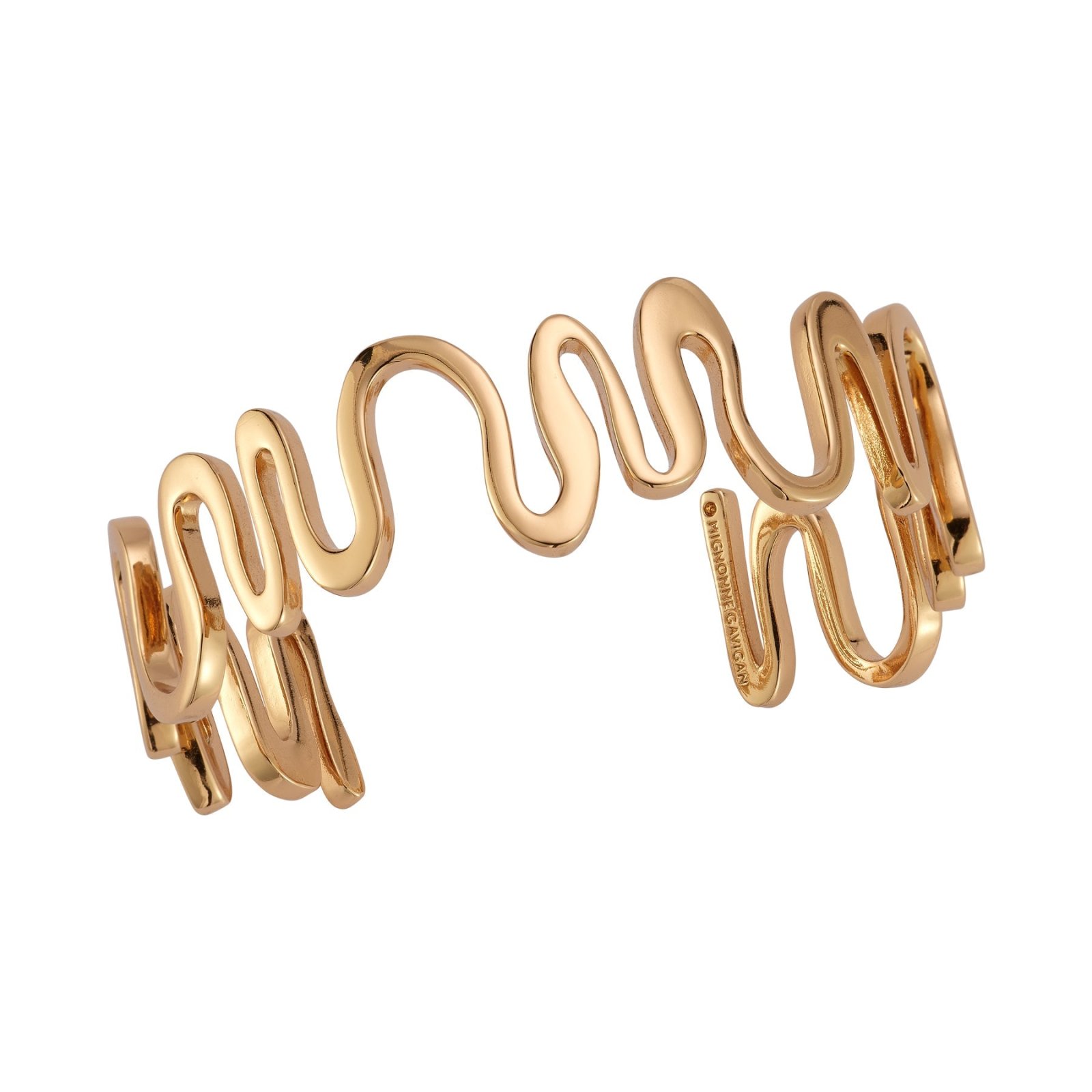
Martina Cuff
A bold, back-and-forth golden design with a polished, undulating finish that works as a sculptural focal point or layered with other gold pieces. Fully adjustable: squeeze to tighten or gently open to widen for any wrist. This is the piece that makes a plain white shirt look considered.
Jewelry That Goes With Everything: Picking Your Core Pieces
Jewelry that goes with everything shares three traits: a neutral metal tone, a compact scale, and a finish that survives daily wear.
Use this checklist before you commit to a piece:
- Does the metal tone match at least two other pieces you own?
- Is the scale small enough for a work meeting and a weekend brunch?
- Does the closure feel secure enough for all-day wear?
If a piece fails two or more of those, it is a costume purchase, not a core piece. That is fine occasionally, but it should not be the foundation of a set.
Everyday Gold Jewelry: Material Quality and Care
Gold-plated, gold vermeil, and solid gold are three different things, and the difference decides how long a piece stays looking new.
Plated vs. vermeil vs. solid: the actual difference
- Gold-plated jewelry carries a thin layer of gold over a base metal, usually brass or a copper alloy. The gold layer is typically measured in fractions of a micron. It is the most affordable option and the fastest to show wear at high-friction points like earring posts and ring bands.
- Gold vermeil uses a thicker gold layer, commonly 2.5 microns or more, over a 925 sterling silver core. The sterling silver core matters as much as the gold thickness: silver is a more stable base than brass, and it is the reason vermeil typically outlasts standard plating. In this edit, the 18K Gold Vermeil Earrings use a recycled 925 sterling silver core with a 3.0-micron layer of 18K gold, which is at the thicker end of the vermeil range.
- Solid gold is gold all the way through, usually 14K or 18K. It does not wear through because there is no layer to wear through. It is the longest-lived option and the highest upfront cost.
A practical rule: the thicker the gold layer and the more stable the core, the longer the finish holds.
Skin sensitivity and nickel
If your skin reacts to cheap jewelry, the culprit is usually nickel in the base metal. Sterling silver and gold vermeil over sterling silver are lower-risk starting points than brass-based plating, because the silver core sits between your skin and the gold layer. Solid gold is the lowest-risk option of all. If you have a known nickel allergy, patch-test any new piece on a small area before wearing it all day, and prioritize pieces that specify a sterling silver core rather than a brass base.
How to assess a durability claim
- Micron thickness. A stated number (for example, 3.0 microns of 18K gold) is a specification. 'Heavy plating' with no number is not.
- Core metal. Sterling silver, brass, and stainless steel behave differently. Sterling silver and stainless steel are more stable bases than brass.
- Closure type. A classic post with a secure back outlasts a friction-fit backing on a daily-wear earring. For cuffs, an adjustable open design avoids the sizing failure that fixed cuffs run into.
Care that actually extends finish life
Care advice is consistent across plated and vermeil pieces, and worth following because finish wear is cumulative:
- Store pieces in a dry jewelry box or soft pouch, separated so they do not scratch each other.
- Apply perfume, lotion, and hair products first, let them dry, then put jewelry on. Spraying fragrance directly onto a plated or vermeil piece is the fastest way to dull the finish.
- Remove pieces before swimming, bathing, or exercising. Chlorine and sweat both accelerate finish wear.
Matching material to wear frequency
The most useful buying rule is matching material tier to wear frequency. A piece worn twice a week can be entry-tier plating and still look new for a long time. A piece worn every day, your daily driver, is where vermeil or solid gold earns its higher upfront cost, spread across far more wears.
Minimalist Jewelry Styling Ideas for Work and Weekends
For the office, wear one earring and one bracelet.

For weekends, layer. Put the Petite Crystal Madeline studs in a first piercing and the 24K Vermeil Huggies in a second, then add the cuff on the arm you gesture with.
For evenings, swap the stud for the Icon 14K Gold-Plated Earrings and keep everything else the same. One change, a different register.
The rule underneath all three: keep the metal tone consistent and let one piece carry the volume. Two bold pieces compete.
Conclusion
The hardest part of minimalist dressing is not buying less, it is buying pieces that cooperate.
That is what we curate for at Rick's by Design: a tight edit of on-trend, budget-friendly pieces built to layer with each other, so getting dressed feels like a decision you already made. Shop the collection and start with one earring you will wear tomorrow, then build from there.