

Accurate Sizing Guides: Bring Joy to Your Wardrobe
Table of Contents
- Why Accurate Sizing Guides Bring Joy to Your Wardrobe
- How to Measure Yourself for Clothes: A Step-by-Step Workflow
- How to Find Your Clothing Size Using a Women's Clothing Size Chart
- Women's Clothing Size Chart: Comparing Your Measurements to Garment Sizing
- How Clothes Should Fit: Ease, Fabric, and Silhouette
- Between Sizes or Between Brands? How to Choose
- Fit Troubleshooting After Delivery
- Conclusion
Last Updated: October 21, 2026
Why Accurate Sizing Guides Bring Joy to Your Wardrobe
Accurate sizing guides turn online shopping from a gamble into a confident choice. At Rick's by Design, we know that the right fit is what makes a dress feel like it was made for you.
Here is the good news: finding your size takes about ten minutes and one soft tape measure.
Most fit guides skip the hard part. They hand you a chart and wish you luck.
How to Measure Yourself for Clothes: A Step-by-Step Workflow
Measuring yourself for clothes takes four steps: measure your bust, waist, and hips over light clothing, then write each number down. Do it in front of a mirror so the tape stays level. The whole process takes about ten minutes.
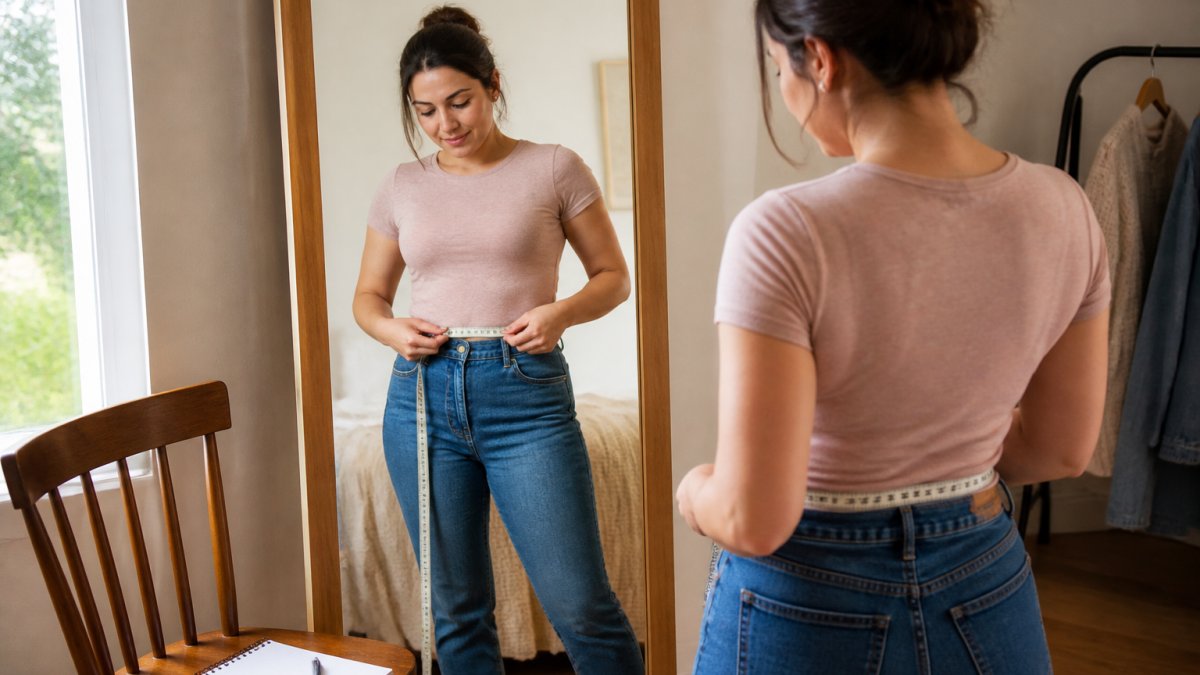
Woman in a fitted top using a soft tape measure to record her natural waistline on a notepad.
Here is the sequence we recommend:
- Wear fitted clothing. A thin top and leggings give the truest read. Bulky layers add inches that are not yours.
- Stand tall and relaxed. Breathe normally. Do not suck in or puff out.
- Measure the bust. Wrap the tape around the fullest part of your chest, keeping it level across your back.
- Measure the waist. Find the narrowest point of your torso, usually just above the belly button.
- Measure the hips. Stand with feet together and wrap the tape around the fullest part of your seat.
- Record every number. Write them down in inches and keep them in your phone notes.
A common mistake is pulling the tape tight. The tape should sit snug against your body without pressing in. If it leaves a mark, it is too tight.
Bust, Waist, and Hip: The Three Measurements That Matter Most
Bust, waist, and hip measurements drive almost every women's clothing size chart. The bust is measured around the fullest part of your chest. The waist is the narrowest part of your torso. The hips are the fullest part of your seat, usually about 8 to 9 inches below your natural waist.
Get these three right and most size charts will point you to a solid starting size.
Reading a Tape Measure Without Guessing
Read the number where the tape's end meets the tape body, not where the metal tip begins. Most soft tape measures mark inches on one side and centimeters on the other. Stick with one system and stay consistent.
Round to the nearest quarter inch. A half-inch difference rarely changes your size, but it helps to be precise when you compare against a detailed measurement chart.
How to Find Your Clothing Size Using a Women's Clothing Size Chart
Finding your clothing size means matching your body measurements to the size range on the brand's chart, not to the size you wear in another store.
Take our Women's High-Waist Wide-Leg Casual Pants as an example. The size chart lists bust, waist, and hip ranges for each size from XS to 2XL. A 28-inch waist points to a medium.
The key is to compare all three numbers, not just one. If your waist says medium but your hips say large, read the garment notes before you choose.
Women's Clothing Size Chart: Comparing Your Measurements to Garment Sizing
A women's clothing size chart is a reference table that pairs letter or number sizes with body measurement ranges. Comparing your measurements to garment sizing means checking where each of your three numbers lands, then picking the size that fits the most numbers at once.
Here is a sample chart based on the sizing in our collection:
Size |
Bust (in) |
Waist (in) |
Hips (in) |
|---|---|---|---|
XS |
32-33 |
24-25 |
34-35 |
S |
34-35 |
26-27 |
36-37 |
M |
36-37 |
28-29 |
38-39 |
L |
38-39 |
30-31 |
40-41 |
XL |
40-41 |
32-33 |
42-43 |
2XL |
42-43 |
34-35 |
44-45 |
When your numbers span two sizes, follow the chart for the garment type. A fitted knit dress that runs small, like our Slim-Fit Ribbed Knit Midi Dress, calls for the larger end: size up. A loose wide-leg pant gives you room to move.
How Clothes Should Fit: Ease, Fabric, and Silhouette
Clothes should fit with ease, which is the extra room built into a garment beyond your body measurements. A tailored blazer has less ease than a flowing wide-leg pant. Neither is wrong. The intended fit tells you what the designer had in mind.
Fabric changes everything. A ribbed knit with spandex stretches and recovers. A crisp woven cotton holds its shape and shows every pull. Two dresses in the same size can feel completely different because of how the fabric drapes.
Stretch, Drape, and Why Two Size M Dresses Fit Differently
Consider two dresses, both labeled medium. One is a slim-fit ribbed knit like our Slim-Fit Ribbed Knit Midi Dress, which skims the body from shoulder to mid-calf. The other is a structured woven shift with no stretch.

Women's Slim-Fit Ribbed Knit Midi Dress | Zip Collar & Lantern Sleeves
The knit dress moves with you and forgives a half-inch. The woven dress does not. Same size label, very different fit. That is why the fabric note on a product page matters as much as the chart.
Garment-Specific Fit Rules Beyond Tops and Dresses
Bottoms, outerwear, and jumpsuits each follow their own fit logic:
- High-waist pants: Measure your natural waist, not where you wear low-rise jeans.
- Puffer jackets: Size up if you plan to layer a sweater underneath, as our Packable Puffer Jacket notes.
- Jumpsuits: The torso length matters as much as the waist. Check the rise if the chart lists it.
- Footwear: Our Chunky Heel Wedge Pumps use European sizing, so convert with the chart before you order.
Between Sizes or Between Brands? How to Choose
When you fall between sizes, size up for comfort and size down for a closer fit. That single rule resolves most between-size decisions. For between-brand differences, trust the chart on the page in front of you, not the size tag in your closet.


Here is the decision framework we use:
Situation |
What to do |
Why |
|---|---|---|
Between sizes in a fitted knit |
Size up |
Knits cling; a little room reads smoother |
Between sizes in a structured woven |
Size down |
Wovens relax slightly with wear |
Between sizes in outerwear |
Size up |
Room for layering |
Brand chart differs from your usual size |
Follow the current chart |
Sizing varies by brand and supplier |
A common mistake is ordering your usual size out of habit. Brand sizing shifts, and a chart built for one supplier says nothing about another. Read the numbers every time.
Fit Troubleshooting After Delivery
Fit problems after delivery usually trace back to one measurement, and most are fixable without a return. Try the garment on with the shoes and underlayers you plan to wear, stand in front of a mirror, and run through this diagnostic sequence before you decide what to do.
Step 1: Identify the Problem Zone
Check these five spots in order. The first one that fails tells you what to fix:
- Shoulders and bust: Gapping at the neckline, pulling across the chest, or a button that strains means the bust or shoulder measurement is off.
- Waist: A waistband that digs in, rides up, or leaves a red mark means the waist is too small. A waistband that gaps at the back means it is too large.
- Hips and seat: Pulling across the front, visible pocket flare, or a seam that strains means the hip measurement is too small.
- Torso length: A waist seam that sits above or below your natural waist, or a crotch that hangs low, means the torso or rise is wrong for your frame.
- Length: Hem length is the easiest fix. Almost any hem can be shortened; very few can be lengthened.
Step 2: Decide Exchange, Tailor, or Keep
Use this framework to choose the right next step:
Problem |
Best move |
Why |
|---|---|---|
Shoulders or bust too tight |
Exchange for a larger size |
Shoulders are the hardest alteration; tailoring rarely fixes them cleanly |
Waist slightly loose |
Tailor |
Taking in a waist seam is a standard, low-cost alteration |
Hips too tight |
Exchange for a larger size |
Letting out hip seams is limited by seam allowance and rarely looks clean |
Hem too long |
Tailor |
Shortening a hem is simple and preserves the fit everywhere else |
Sleeves too long |
Tailor |
Sleeve length is one of the easiest alterations |
Fabric pulls or clings in a way you dislike |
Exchange for a different fabric or cut |
The size may be right; the fabric is the issue |
Everything fits except one spot |
Tailor |
A single small adjustment is usually cheaper and faster than a return |
Step 3: Check the Fabric Before You Decide
Fabric determines whether a fit problem will improve or worsen with wear. A structured woven will not stretch, so a tight hip today will still be tight next month. A high-stretch knit may relax slightly, so a snug fit can settle into comfort after a wear or two. If the garment is a blend with elastane, expect a small amount of give; if it is pure linen or cotton poplin, expect none.
Step 4: When to Contact the Shop
If the garment's actual measurements differ from the size chart on the product page, contact the shop directly with your three body measurements and the garment's flat measurements. Real humans can compare your numbers against the actual garment and tell you whether a different size will solve the problem or whether the cut is simply wrong for your shape. That conversation beats guessing every time, and it often saves a week of shipping back and forth.
Conclusion
Online shopping only feels risky when the sizing is a mystery. Measure once, compare against the chart on each product page, and read the fabric notes. That routine turns fit guesswork into a confident habit.
At Rick's by Design, we built our collection to make that easy. Size ranges vary by style, and many pieces run XS to 2XL as shown in the chart above. You'll find detailed size charts on every product page, plus pieces chosen to bring joy to your everyday wardrobe. Shop now and find the fit that feels like you.