

How to Spot Quality Clothing Online: 2026 Guide
Table of Contents
- Why Quality Is Harder to Judge Online
- Best Fabrics for Long-Lasting Clothing
- How to Identify High Quality Fabric Online
- Signs of Well-Made Clothing in Product Photos
- How to Spot Quality Clothing Online Using Reviews and Return Policies
- How to Spot Quality Clothing Online: Building Your Evaluation Checklist
- Frequently Asked Questions
Last Updated: September 27, 2026
Why Quality Is Harder to Judge Online
How to spot quality clothing online can be a challenging task. You can't touch the fabric through a screen, which is why so many online shoppers end up disappointed. But the details that reveal quality are already in the listing, if you know where to look.
Best Fabrics for Long-Lasting Clothing
The best fabrics for long-lasting clothing hold their shape and color through repeated washing. Natural fibers like cotton, linen, and wool age well; synthetic blends add stretch and wrinkle resistance but vary widely in quality. A 100% cotton tee and a 60/40 cotton-poly blend are different products, neither is automatically better.
- Cotton: Breathable, soft, gets better with age. Look for long-staple or Pima labels.
- Linen: Strong and cool, but wrinkles. Quality linen softens over time.
- Wool: Warm, odor-resistant, holds shape. Merino is finer and less itchy.
- Silk: Lightweight and temperature-regulating. Watch for "silk-like" wording, which means synthetic.
- Polyester: Durable and cheap, but traps odor. Fine in small percentages.
- Viscose and rayon: Soft and drapey, but weaker when wet.
Natural Fibers vs. Synthetic Blends
A blend isn't a red flag by itself: a little elastane gives denim stretch, and a touch of nylon makes wool stronger. The problem starts when synthetics replace natural fibers to cut cost while the price stays the same.
Decoding Technical Specs: GSM, Denier, Ply, and Gauge
These four terms tell you more about fabric quality than any marketing copy.
- GSM (grams per square meter): Fabric weight. Heavier isn't always better, but it signals density. A 180 GSM tee is light; 220 GSM feels substantial.
- Denier: Fiber thickness, mostly for synthetics and hosiery. Lower denier means finer, sheerer fabric.
- Ply: How many yarn strands are twisted together. Two-ply cotton is stronger and smoother than single-ply.
- Gauge: Knit density, common in sweaters. Higher gauge means a finer, tighter knit.
How to Identify High Quality Fabric Online
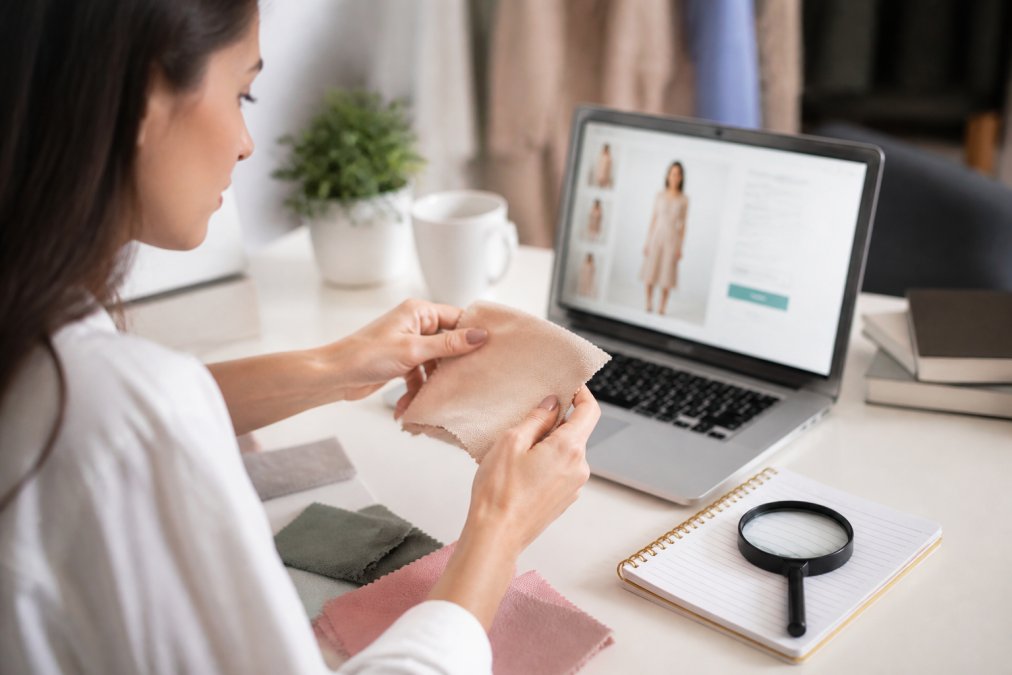
Start with the fiber content and care label, then study the product photos. Together these steps tell you more about how to identify high quality fabric online than any description paragraph.
Reading Fiber Content and Care Labels
The care label is the most honest part of any listing.
- Fiber percentages: Listed highest to lowest. A "cashmere sweater" that's 5% cashmere and 95% acrylic is an acrylic sweater.
- Care instructions: "Dry clean only" on a casual item is a warning, the fabric may shrink, bleed, or pill in a home wash.
- Country of manufacture: Not a quality guarantee either way, but it often hints at production scale.
- Lining details: A listed lining material (like polyester or cupro) shows the brand thought about construction.
Digital Fabric Analysis and Product Photography
Zoom in on every photo; that zoom button is your microscope.
Signs of Well-Made Clothing in Product Photos
Well-made clothing shows specific visual markers: straight seams, matched patterns, clean edges, and hardware that sits flush. Manufacturers cut corners in predictable places; learn those places and you can judge a garment in thirty seconds.
Checking Stitching Density and Seam Allowance
Stitching density means how many stitches per inch. Denser stitching holds up better under stress.
- Look for: Even, straight lines with no gaps or loose threads
- Check: High-stress areas like shoulders, armholes, and crotch seams
- Avoid: Single-stitched seams on heavy fabrics
- Watch for: Puckered fabric along a seam, which signals poor tension control
Assessing Hardware, Fasteners, and Finishing Details
Hardware tells you a lot about the price point a brand was aiming for.
- Buttons: Thick, securely attached, with tight thread. Plastic is fine; flimsy is not.
- Zippers: Metal teeth and smooth pulls beat cheap plastic. Check that the zipper tape matches the fabric color.
- Hems: A clean, even hem with invisible stitching signals care. Wavy or uneven hems signal rush.
- Lining: A full lining protects the outer fabric and improves drape.
How to Spot Quality Clothing Online Using Reviews and Return Policies
Reviews and return policies are your best defense against a bad purchase: they tell you how a garment behaves after it arrives, not just how it looks in a studio. Filter reviews by your own size and body type; a five-star review from someone built differently tells you almost nothing.
Sizing Consistency and Customer Reviews
Sizing consistency is the number one complaint in online apparel. Read reviews asking one question: does this brand run true to size?
- Search reviews for: "runs small," "true to size," "size up"
- Look for photo reviews: Real customers in real lighting
- Check repeat buyers: Someone who bought three times trusts the brand
- Ignore: Reviews that only mention shipping speed
Return Policy as a Quality Indicator
A generous return policy is a confidence signal. Brands that expect you to keep the item make returns easy; brands that expect complaints bury the policy in fine print. Free returns with no restocking fees and a long window mean the company is betting you'll be satisfied with the construction and fit.
Read the fine print before you buy:
- Is return shipping free, or do you pay?
- How many days do you have?
- Are sale items excluded?
- Is there a restocking fee?
The Price-per-Wear Calculation: When Paying More Saves Money
Run the math before you buy:
| Item | Price | Wears | Cost per Wear |
|---|---|---|---|
| Trend top | Low | 3 | High |
| Everyday blazer | Medium | 40 | Low |
| Classic jacket | Higher | 100+ | Lowest |
By combining review analysis, a critical look at return policies, and price-per-wear calculations, you can make smarter online purchases that stand the test of time.
How to Spot Quality Clothing Online: Building Your Evaluation Checklist
Use this checklist before every online purchase. It takes about five minutes and saves you the cost of returns and disappointment.
Fabric and specs:
- Fiber content listed with percentages
- Care instructions match how you'll actually wash it
- GSM, ply, or gauge mentioned for knits and tees
- Natural fibers lead the blend, or synthetics are used with purpose
Photos:
- Close-up shots show visible weave or knit
- Multiple angles including back, inside, and hardware
- Consistent lighting across all photos
- Model photos show the garment on different body types
Construction:
- Seams look straight and even
- Buttons and zippers look solid
- Hems are clean and even
- Lining is described, not just implied
Reviews and policy:
- Reviews mention sizing consistency
- Photo reviews from real customers exist
- Return policy is clear and easy to find
- Return shipping terms are stated upfront
Value:
- Price per wear makes sense for your lifestyle
- The piece works with at least three outfits you already own
- You'd buy it again at full price
Frequently Asked Questions
What are the best fabrics to look for when shopping for quality clothing?
Natural fibers like cotton, linen, silk, and wool tend to outperform synthetic blends in durability and breathability. Look for higher GSM (grams per square meter) for knits, longer staple cotton for softness, and full-grain leather for accessories. Blends can work well when the natural fiber content is high. Always check the fiber content label and read customer reviews about shrinkage resistance and colorfastness before buying.
How can you tell if a garment is well-made just by looking at online photos?
Zoom in on stitching density, seam allowance, and hem quality. Well-made clothing shows consistent, tight stitches, clean seam finishes, and symmetrical patterns. Check button attachment and zipper functionality in close-ups. Look for lining materials that match the garment's quality. Product photography that shows interior seams, hardware close-ups, and fabric texture is a strong sign the brand stands behind its construction.
What is the 3-3-3 rule for clothes?
The 3-3-3 rule suggests building a wardrobe where each piece can be worn in at least three different settings, styled three different ways, and last at least three years. It encourages buying fewer, higher-quality items instead of fast fashion. When shopping online, use this rule to assess versatility, durability, and price-per-wear before adding an item to your cart.
Why do some online clothing items look different in person than in photos?
Lighting, editing, and model styling can distort color, texture, and fit. Brands that include unedited customer photos, detailed fabric close-ups, and honest sizing notes reduce this gap. Check reviews for mentions of color accuracy and sizing consistency. A generous return policy also signals confidence in how the product matches its listing, making it easier to buy with less risk.
Judging quality online comes down to patience and a few repeatable checks. Most shoppers skip the specs and photos, then blame the brand when the item disappoints. You don't have to be most shoppers.
At Rick's by Design, we curate pieces meant to be worn again and again, with clear details and honest photos so you can judge before you buy. Shop Now and build a wardrobe that earns its keep.