

Why Curated Fashion Is Worth the Price: 2026 Guide
Table of Contents
- The Real Cost of a Cheap Wardrobe
- How the Cost Per Wear Formula Changes Everything
- How to Identify Quality Fabrics Before You Buy
- Why Curated Fashion Is Worth the Price for Your Personal Style
- How to Build a Capsule Wardrobe on a Budget
- The Hidden Labor and Psychology Behind a Curated Collection
- Frequently Asked Questions
Last Updated: September 25, 2026
The Real Cost of a Cheap Wardrobe
The benefits of curated fashion 2026 show that a low price tag hides a bigger number. Cheap garments often lose shape, pill, or fade after a handful of washes, which pushes you back to the store sooner than you planned. That cycle is the real expense.
Curated fashion flips the math. Instead of buying often and replacing constantly, you buy fewer pieces chosen with a clear purpose. Rick's by Design built its collection around that idea: fewer, better-chosen pieces that work across occasions rather than a closet full of maybes.
Think about the last item you replaced within a year. If it cost $20 and lasted six months, you are on track to spend $40 a year on that one garment. A better-made piece that lasts three years at $60 costs $20 a year. The cheap option was never cheap.
How the Cost Per Wear Formula Changes Everything
Cost per wear is the purchase price divided by the number of times you actually wear the item. It is the single most useful number in a wardrobe decision, and almost nobody calculates it before buying.
A $36 dress worn twice a month for two years works out to roughly $0.75 per wear. A $15 top worn once and abandoned costs $15 per wear. That gap is why the benefits of curated fashion 2026 matter more than the sticker price.
Running the Numbers on a Single Purchase
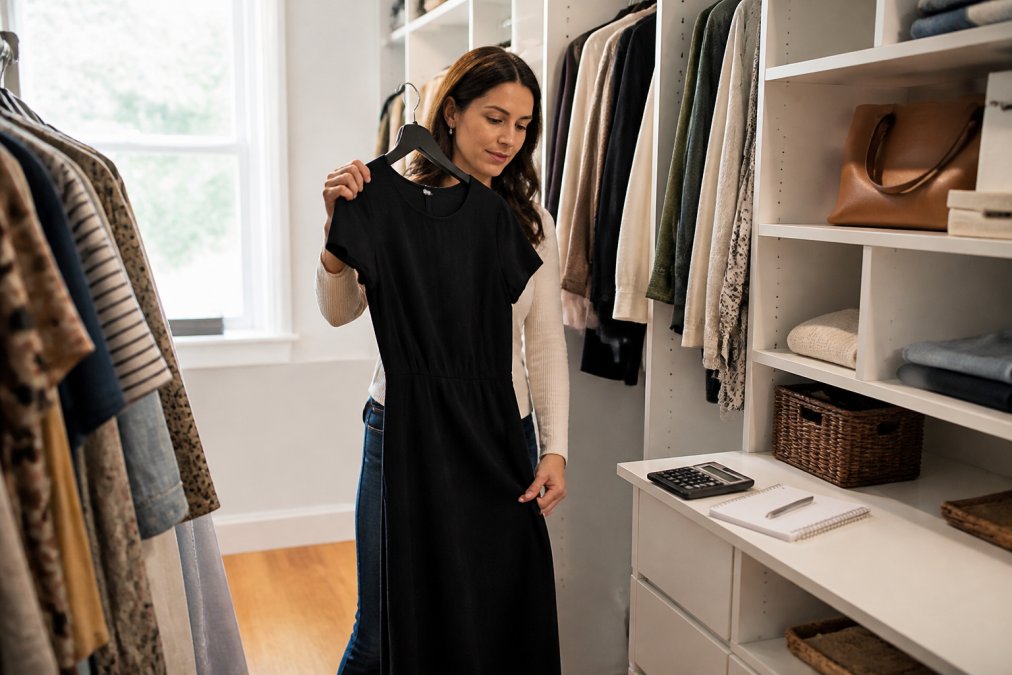
Take the Elegant Black Ribbed Midi Dress at $35.99. It has long sleeves, a midi length, a side slit, and stretch fabric, and the brand lists it for work, brunches, dinner dates, and evening events. Say you wear it twice a month for two years: 48 wears, about $0.75 each.
Now compare a $15 fast-fashion dress worn three times before it loses shape. That is $5 per wear. The dress that cost more than twice as much was seven times cheaper to own.
How to Identify Quality Fabrics Before You Buy
Quality shows up in three places: the fiber content, the construction, and the finishing. Learn to read those and you can judge a garment without touching it.
Start with the label. Natural fibers and quality blends hold shape and breathe better than loosely woven synthetics. Then check how the fabric behaves: does it spring back when stretched, or stay stretched out?
Stitching, Lining, and Hardware Checks
Small details separate a garment that lasts from one that does not.
- Stitching: Look for even, tight, straight seams with no loose threads or skipped stitches.
- Lining: A lined garment drapes better and protects the outer fabric. The Women's Faux Leather Stand Collar Blazer uses a breathable lining, which helps it layer smoothly.
- Hardware: Zippers, buttons, and clasps should feel solid, not flimsy.
- Finishing: Check hems, cuffs, and the inside of the collar for clean, secure finishing.
Material durability is not about thickness alone. A tightly woven fabric in a mid-weight can outlast a heavy, loosely woven one.
Why Curated Fashion Is Worth the Price for Your Personal Style
Curated fashion is worth the price because it replaces guesswork with a cohesive vision. A curated collection is a small, deliberate set of pieces chosen so they work together, which means fewer decisions and more outfits from the same wardrobe.
That is the difference between mass-market shopping and curation. Mass-market shelves give you volume and low prices. Curation gives you a point of view.
Harvard Business Review on the psychology of choice overload has documented how too many options slow decisions and reduce satisfaction.
How to Build a Capsule Wardrobe on a Budget
A capsule wardrobe is a small set of versatile pieces you rotate consistently. The budget version is not about buying cheap items. It is about sequencing purchases so each new piece multiplies the outfits you already own instead of sitting alone in the closet.
Step 1: Audit Before You Buy
Before spending anything, pull everything out of your closet and sort it into three piles: wears often, wears rarely, never wears. Most people find that roughly a fifth of their closet does most of the work. That is your real baseline.
Step 2: Set a Per-Piece Budget, Not a Total
A total budget encourages you to spread money thin across many cheap items. A per-piece budget forces you to ask what a single garment is worth to you. A common pattern is to cap the first capsule at a number you can absorb in one month without carrying a balance, then add one piece per pay period.
Step 3: Start With Five Pieces That Cover Most of Your Week
Each piece should serve at least three outfits. If it cannot, it does not earn a slot yet.
- A black midi dress for work and evenings, like the Elegant Black Ribbed Midi Dress ($35.99)
- A statement skirt that dresses up or down, like the Leather Patchwork High-Waist Maxi Skirt ($30.92)
- A structured layer, like the Women's Faux Leather Stand Collar Blazer ($59.99)
- A coordinated set for low-effort days, like the Two-Piece Knit Dress Set ($27.99)
- One piece of jewelry that finishes everything, like the 18K Gold Vermeil Earrings ($58.00)
Step 4: Test the Math Before You Add a Sixth Piece
Run a quick cost-per-wear estimate on the piece you are considering. Divide the price by the number of times you realistically expect to wear it in the next year. If the result is higher than the cost per wear of something you already own and wear weekly, the new piece is not pulling its weight yet.

Step 5: Rotate, Don't Accumulate
A capsule only works if pieces leave as well as enter. Once a season, pull out anything you did not wear and ask why. Sometimes the answer is fit. Sometimes it is that the piece never had a partner in the closet. Fix the partner problem before you blame the piece.
The Hidden Labor and Psychology Behind a Curated Collection
Curation looks effortless from the outside, which is exactly why people underestimate it. The markup on a curated piece is not paying for the fabric alone. It is paying for the hours of work that happened before the piece ever reached a product page.
What Curation Actually Involves
The visible part is the garment. The invisible part is a sequence of decisions:
- Sourcing: Reviewing samples from multiple suppliers and rejecting most of them for fit, drape, or finish.
- Vetting: Wearing or washing test pieces to see how they hold up after repeated use, not just on day one.
- Fit testing: Checking how a piece sits on different body types, not just a single sample size.
- Styling: Deciding what a piece pairs with, so it does not arrive as an orphan in your closet.
- Editing: Cutting anything that does not fit the collection's point of view, even if it would sell on its own.
Why the Psychology Matters More Than the Aesthetics
A wardrobe that fits together removes the daily friction of "what do I wear," and that friction adds up. Decision fatigue is not a metaphor. Each small choice draws on the same limited pool of attention you need for work, parenting, and everything else.
The Sustainability Argument, Reframed
Conscious consumption fits here too, but not in the way most brands frame it. Buying fewer, better pieces reduces waste not because the pieces are virtuous, but because a smaller wardrobe is easier to trace, easier to maintain, and easier to repair. Material durability and quality craftsmanship are not just selling points; they are the reason a piece stays in rotation instead of the donation bin.
Frequently Asked Questions
How does a curated wardrobe save money over time?
A curated wardrobe saves money through higher wear frequency per item. When a $35.99 dress gets worn 40 times, that is under $1 per wear. A $15 fast-fashion top worn three times costs $5 per wear. Curated pieces also last longer because of better construction and material durability, so you replace them less often. Fewer replacements plus more wears per garment equals real savings within a year.
What is the cost per wear formula and how do I use it?
Divide the purchase price by the number of times you expect to wear the item. A $59.99 blazer worn twice a week for a year works out to roughly $0.58 per wear. Before buying, estimate honestly how many outfits the piece fits into. If the number is under ten, the cost per wear stays high and the purchase rarely justifies itself.
How do I identify high-quality clothing worth the investment?
Check three things: fabric content, stitching, and lining. Look for natural fibers or quality blends listed on the label. Inspect seams for tight, even stitching without loose threads. A lined garment holds its shape longer and feels better against the skin. Also check hardware like zippers and buttons. These details separate investment pieces from fast fashion that loses shape after a few washes.
Is it better to have fewer high-quality items or many cheap ones?
Fewer high-quality items usually win on both cost and confidence. A small rotation of well-made pieces reduces decision fatigue, keeps your outfits consistent, and lowers total spending because you stop replacing worn-out items. A two-piece knit set at $27.99 that mixes into multiple outfits often outperforms five separate cheap tops that each get worn once or twice.