

How to Verify Online Clothing Sizing: A Step-by-Step Guide
Table of Contents
- Why Verifying Online Clothing Sizing Matters
- How to Measure Body for Clothes Accurately
- How to Read Garment Measurements and Size Charts
- Using Existing Garments to Verify Fit
- Reading Customer Reviews for Sizing Insights
- How to Avoid Returns When Buying Clothes Online
- Frequently Asked Questions
Last Updated: September 19, 2026
Why Verifying Online Clothing Sizing Matters
You can't try clothes on before buying online, making verify online clothing sizing essential for anyone who shops for clothes on the internet.
A poor fit means returns, wasted time, and frustration. Taking time to verify sizing before checkout saves money and keeps more pieces in your closet.
Verifying sizing doesn't require guesswork: use your own measurements, study size charts, and learn from customer reports.
How to Measure Body for Clothes Accurately
Taking accurate body measurements is the foundation of verifying online clothing sizing. Most sizing mistakes happen because people guess instead of measuring properly.
Use a flexible measuring tape (not a rigid ruler). Wear fitted clothes so the tape sits against your body without compression. A second set of hands makes measurements more reliable.
Measuring Bust Circumference
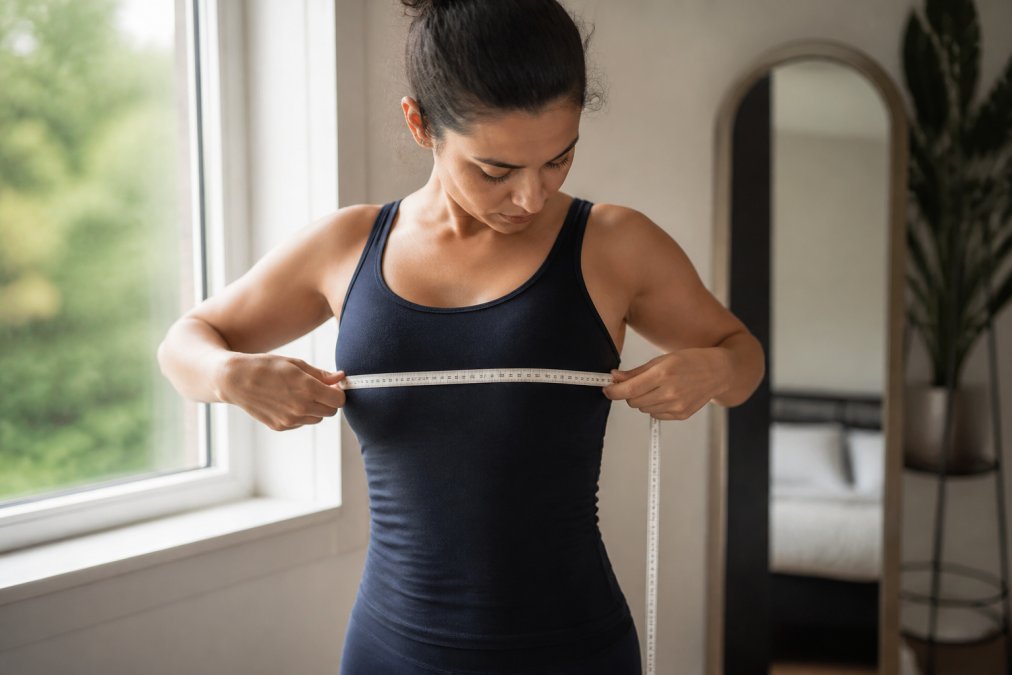
Wrap the measuring tape around your chest at the widest point, keeping it parallel to the floor and snug but not tight. This bust circumference is the primary sizing reference for tops, dresses, and jackets.
Measuring Waist and Hip Circumference
Measure your waist at the narrowest part of your torso, keeping the tape parallel to the ground. Measure your hips around the fullest part, usually 7-9 inches below your waist. Hip and waist measurements are especially important because they vary more between body types.
Measuring Inseam and Length
Inseam is the distance from your inner thigh to your ankle (wear the shoes you plan to pair with pants). For dresses and tops, measure from your shoulder to your desired hem length and stick with one method for consistency.
How to Read Garment Measurements and Size Charts
Size charts vary wildly between retailers, which is why reading actual garment measurements beats relying on size labels alone. You also need to understand how fabric affects fit.
Understanding Retailer Specifications
Look for measurements listed in inches or centimeters: bust, waist, hip, total length, sleeve length, and inseam. Some retailers measure garments flat; others use a dress form. A garment measured flat will be about 2 inches wider than the same garment measured on a body.
How Fabric Composition Changes the Fit Equation
Two garments with identical measurements can fit completely differently depending on fabric. Understanding fabric behavior is essential for accurate sizing verification.
Natural fibers like cotton and linen are less forgiving. Cotton shrinks 3-5% in the first wash. If buying 100% cotton or linen, consider sizing up slightly if you plan to wash in warm water.
Synthetic blends and stretch fabrics behave differently. A cotton-polyester blend with elastane will stretch and conform to your body, making a garment feel smaller than its flat measurements. Rigid synthetics like 100% polyester won't stretch, so measurements are more literal.
Knit fabrics (jersey, rib, fleece) have inherent stretch and expand when you move. A knit dress measuring 36 inches might accommodate a 38-inch bust comfortably. Woven fabrics don't stretch, so measurements are fixed.
Structured fabrics like denim and canvas don't give much. Always check fiber content in the product description. The presence of spandex, elastane, or lycra signals stretch. High percentages of natural fibers signal less stretch and potential shrinkage.
Comparing Your Body Measurements to Size Charts
Place your body measurements next to the retailer's garment measurements and look for the size that matches most closely. If your bust is 36 inches and a size 6 has a 36-inch bust, it should fit, but only if the fabric is non-stretch. If the fabric contains spandex, size up because the stretch will make it feel snug. Check waist and hip measurements too. This two-minute comparison prevents most sizing mistakes.
Recognizing Brand-Specific Sizing Variance
Some brands run small or large; some cut generously through the hips but snug through the chest. Check the retailer's fit description, words like "oversized," "slim," or "classic fit" tell you what to expect. Keep notes on brands that work well for your body and which fabrics feel best.
Using Existing Garments to Verify Fit
Your closet holds the most reliable sizing reference available: garments that already fit your body the way you want them to. This method bypasses brand confusion entirely because you're comparing actual physical dimensions to actual physical dimensions, not relying on size labels or retailer claims.
How to Measure a Reference Garment
Start by selecting a top, dress, or pair of pants that fits you perfectly. This should be something you reach for regularly and feel confident wearing. Lay the garment flat on a clean, hard surface like a table or floor.
Measure from the center of one shoulder seam to the center of the other shoulder seam for shoulder width. For bust or chest, measure across the garment horizontally at the fullest point, typically 2 inches below the armpit. Measure waist at the narrowest point, and hips at the fullest point. For length, measure from the top of the shoulder seam straight down to the hem. If measuring pants, measure the inseam from the crotch seam to the hem.
Write these measurements down and keep them in a note on your phone or a spreadsheet.
Comparing Your Reference Garment to New Items
When you find an item online, pull up its garment measurements from the retailer's size chart. Place them side by side with your reference garment measurements.
Accounting for Fabric and Cut Differences
This method works best when comparing items made from similar fabrics. A fitted cotton t-shirt won't fit the same as a loose linen shirt, even if their flat measurements are identical. If your reference garment is a structured cotton blend and the new item is 100% silk charmeuse, expect the new item to drape differently and potentially feel looser despite matching measurements.
When This Method Works Best
This approach is most effective for basics: t-shirts, simple dresses, button-ups, and straight-leg pants. It's less reliable for highly structured pieces like tailored blazers or garments with complex seaming, because those depend heavily on internal construction that flat measurements don't capture.
Reading Customer Reviews for Sizing Insights
Customer reviews contain gold for sizing verification. Real shoppers describe how pieces fit on real bodies. They mention whether items run small, large, or true to size. They talk about fit in specific areas, tight in the shoulders, loose at the waist, short in the arms.
How to Avoid Returns When Buying Clothes Online
The best return is the one you never have to make. Preventing sizing mistakes saves time, money, and frustration. Most returns happen because people buy without verifying fit first.
Checking Return Policies Before Purchasing
Before you add anything to your cart, check the retailer's return policy. Some retailers offer free returns. Others charge a fee. Some require returns within 30 days. Others give you 60 or 90 days.
Common Sizing Mistakes to Avoid
The biggest mistake is buying based on your usual size without checking measurements. Your size at one retailer doesn't mean anything at another retailer. Check the actual garment measurements every time.
| Mistake | Why It Happens | How to Avoid It |
|---|---|---|
| Buying your usual size without checking measurements | Assuming size labels are consistent across brands | Compare your body measurements to garment measurements every time |
| Ignoring fabric content | Not realizing how fabric affects fit | Check fiber composition and consider shrinkage and stretch |
| Skipping the length measurement | Focusing only on width measurements | Measure total length and inseam for every item |
| Buying multiple sizes | Hoping one will work without proper verification | Verify sizing before checkout, buy only one size |
Frequently Asked Questions
How do I accurately measure my body for online clothing shopping?
Use a soft, flexible measuring tape and wear fitted clothing or undergarments. Measure your bust at the fullest part, your waist at its natural narrowest point, and your hips at the fullest part of your buttocks. Keep the tape parallel to the floor and snug but not tight. Take measurements twice to verify accuracy. Record all measurements and compare them directly to the retailer's size chart before purchasing.
Why do clothing sizes vary so much between different brands?
Brand-specific sizing variance occurs because manufacturers use different fit standards, fabric composition, and production facilities. A size 8 at one retailer may fit differently than a size 8 elsewhere due to design choices around silhouette, stretch factor, and garment dimensions. This is why comparing your body measurements to each retailer's size chart, rather than relying on your usual size label, is essential for online shopping success.
What should I look for in a brand's size chart to ensure a good fit?
Check that the size chart includes bust circumference, waist measurement, hip measurement, and length specifications. Verify the chart shows garment measurements (how the clothing is sized), not just body size recommendations. Look for detailed fit guides that explain whether the piece runs oversized, true-to-size, or small. Some retailers also note fabric composition, which affects stretch factor and how the garment will move on your body.
How can I use a garment I already own to verify online sizing?
Lay a well-fitting garment flat on a clean surface and measure its bust width (armpit to armpit), waist width, hip width, and length from shoulder to hem. Compare these garment dimensions to the online retailer's size chart for the item you're considering. This method accounts for your personal fit preference and any brand-specific sizing variance, making it one of the most reliable ways to predict whether an online purchase will fit correctly.