

Affordable Work Clothes for Women: 2026 Style Guide
Table of Contents
- Building a Capsule Wardrobe for Work on a Budget
- Essential Workwear Staples Every Woman Needs
- Business Casual Outfits for Women: What Actually Works
- Affordable Work Clothes for Women: Blazers, Dresses, and Skirts
- Workwear for Every Body Type: Petite, Tall, and Plus-Size
- Footwear and Care Tips for Long Office Days
- Conclusion
- Frequently Asked Questions
Last Updated: September 13, 2026
Building a Capsule Wardrobe for Work on a Budget
Building affordable work clothes for women 2026 starts with a simple shift in thinking: fewer pieces, chosen carefully, worn constantly. A capsule wardrobe for work is a small, interchangeable set of garments that mix into many outfits, so you stop buying one-off pieces that only match one thing.
The payoff is real. When every piece works with every other piece, getting dressed takes minutes, and your cost per wear drops with each repeat.
The 3-3-3 Rule Explained
The 3-3-3 rule is a capsule wardrobe framework: three bottoms, three tops, and three layering pieces that all coordinate. That's nine garments producing dozens of outfit combinations, which is why it's the fastest way to build a work wardrobe on a tight budget. Start with neutral trousers, add two blouses and a button-down, then finish with a blazer and two cardigans.
Cost-Per-Wear: The Real Math
Cost-per-wear is the price of a garment divided by the number of times you wear it. A $40 blazer worn twice a week for a year costs far less per wear than a $15 top that sits unworn. This math is why quality fabrics and classic silhouettes beat fast-fashion bargains for office wear.
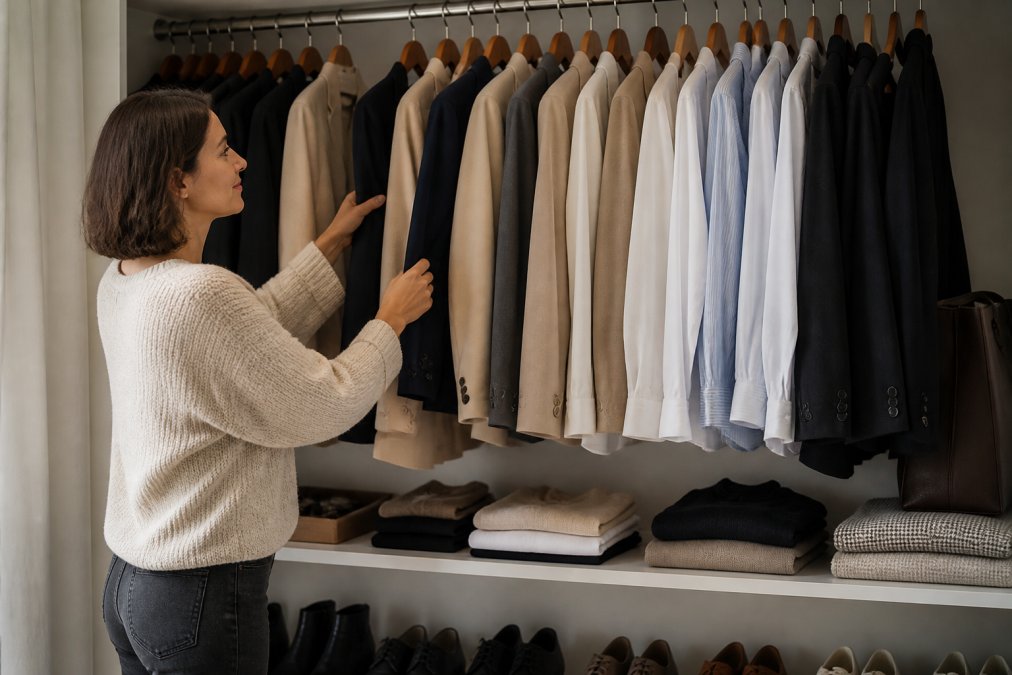
A woman in her 30s organizing a small, curated closet with neutral workwear pieces like blazers, trousers, and button-down shirts hanging neatly
Essential Workwear Staples Every Woman Needs
The core workwear staples are ankle pants, button-down shirts, a tailored blazer, a midi dress, and one pair of comfortable loafers. These five categories cover nearly every office dress code, from smart casual to corporate style, and they layer together without effort.
Trousers and Ankle Pants
Ankle pants are the workhorse of any office wardrobe. Look for a tailored fit that skims rather than clings, in black, navy, or charcoal. A common mistake is buying trousers that fit perfectly while standing but dig in when sitting. Always test the seated fit before you commit.
Button-Down Shirts and Blouses
Button-down shirts anchor professional attire, but the fabric matters more than the cut. Choose cotton blends or crepe that resist wrinkling through a long day. Keep two white or cream options and one in a print you love, and they'll carry you from meetings to dinner.
| Staple | Best For | Fabric to Prioritize |
|---|---|---|
| Ankle pants | Everyday office wear | Stretch cotton blend |
| Button-down shirt | Meetings, presentations | Cotton poplin or crepe |
| Tailored blazer | Layering, polish | Wool blend or ponte |
| Midi dress | One-and-done outfits | Jersey or ponte |
| Loafers | All-day comfort | Leather with cushioned sole |
Business Casual Outfits for Women: What Actually Works
Business casual outfits for women succeed when they balance two polished pieces with one relaxed piece. Think tailored trousers, a knit top, and loafers, or a midi dress with a structured cardigan. The formula keeps you office-ready without veering into weekend territory.
Smart Casual vs. Business Casual
Smart casual leans more relaxed than business casual, allowing dark denim, clean sneakers, and softer fabrics. Business casual stays closer to traditional office polish: no denim, no athletic footwear, and structured silhouettes. When a dress code is unclear, business casual is the safer read.
Affordable Work Clothes for Women: Blazers, Dresses, and Skirts
Affordable work clothes for women come down to three categories that do the heavy lifting: blazers, midi dresses, and pencil skirts. Buy these in neutral tones first, then add color once your base is set. Rick's by Design curates exactly this kind of versatile, budget-friendly piece so you can build a professional aesthetic without overspending.
Professional Blazers and Layering Pieces
A tailored blazer instantly upgrades a plain top and trousers. Choose one structured blazer in black or navy, then add softer layering pieces like cardigans and fine knits for day-to-night transitions. Ponte and wool blends hold their shape far better than thin synthetics.
Midi Dresses and Pencil Skirts
Midi dresses are the most efficient purchase in a work wardrobe: one piece, one outfit, no coordination required. Pencil skirts work the same magic with a tucked blouse. Look for a fit-and-flare or straight cut in a fabric with a little stretch, and you'll stay comfortable through back-to-back meetings.
Workwear for Every Body Type: Petite, Tall, and Plus-Size
Fit is the single biggest reason a budget garment reads as expensive or cheap. Two women can buy the same $35 pair of ankle pants and get completely different results, because the garment was drafted for one body proportion and altered for neither. The fix is not to spend more, it is to know which adjustments matter for your frame and to shop for pieces that already accommodate them.
Petite Frames (Generally Under 5'4")
The core problem is proportion, not size. Standard tops place the waist seam too low and the shoulder seam too wide, which visually shortens the torso. Standard trousers have an inseam that bunches at the ankle. Practical moves:
- Look for petite-specific lines rather than sizing down in regular cuts, a smaller regular size narrows the shoulders but does not raise the waist seam.
- Choose cropped or ankle-length trousers so the hem lands at or just above the ankle bone without tailoring.
- Pick blazers that hit at the high hip rather than mid-thigh; a long blazer on a petite frame swallows the silhouette.
- A monochrome column (same color top and bottom) adds visual height at no cost.
Tall Frames (Generally Over 5'9")
The opposite problem: sleeves end above the wrist, hems float above the shoe, and torsos feel short. Practical moves:
- Prioritize long or tall inseams and check the listed inseam measurement, not the size number.
- Look for long-sleeve tops with extended sleeve length; a 3/4 sleeve on a tall frame reads as a too-short long sleeve.
- Longline blazers and midi dresses work in your favor, the lengths that overwhelm a petite frame flatter a tall one.
- Wider-leg trousers balance a longer leg line better than skinny cuts, which can look stretched.
Plus-Size Frames
The most common mistake is buying a garment sized down and labeled "inclusive", the fit is graded poorly and the fabric pulls. Practical moves:
- Prioritize structured fabrics (ponte, wool blends, heavier crepe) over thin jerseys; structure holds a line and resists clinging.
- Check for true-to-size charts with separate bust, waist, and hip measurements, not a single "size 16" number.
- Look for princess seams, darts, or wrap fronts, these create shape through construction rather than stretch.
- Test the seated fit in any trouser or skirt; a garment that gaps when you sit will gap in a meeting.
The Universal Fit Check
Before you buy anything, take three measurements, bust, natural waist, and hip, and compare them against that specific retailer's chart. Do not assume your size carries across brands. A common pattern is that the same numeric size varies by one to two inches between retailers, which is enough to change how a blazer closes.
The Tailoring Math
A $12 hem or $18 waist take-in at a local tailor can turn a $30 pair of trousers into a garment that fits like a $120 pair. Budget for one or two alterations per season on the pieces you wear most, trousers and blazers, and skip alterations on trend pieces you will replace. This is the highest-return spend in a budget work wardrobe.
Footwear and Care Tips for Long Office Days
Footwear and fabric care are where a budget work wardrobe either pays off or falls apart. A $60 pair of loafers worn five days a week for a year costs about 23 cents per wear; the same pair worn twice and abandoned costs $30 per wear (pubmed.ncbi.nlm.nih.gov). The difference is almost never the price tag, it is rotation, care, and storage.
Footwear That Survives a Full Day
The three categories that hold up best in an office setting are loafers, low block heels (1-2 inches), and ankle boots. What matters more than style is the sole and insole:
- Look for a cushioned insole and a stable, non-slip sole, a thin leather sole with no cushioning is the most common cause of end-of-day foot pain.
- Rotate at least two pairs so each has 24 hours to dry out. Moisture from a full day of wear breaks down the insole and lining faster than any other factor.
- Cedar shoe trees absorb moisture and hold the shoe's shape; they are one of the cheapest longevity tools available.
- Replace insoles rather than shoes when cushioning flattens, a $10-$15 insole can extend a pair by months.
Fabric Care That Extends Life
Most budget garments fail from washing, not wearing. The mechanisms are predictable:
- Heat and agitation break down fibers and cause pilling, fading, and shrinkage. Wash in cold water on a gentle cycle, or hand-wash knits.
- Over-washing is the biggest hidden cost. Trousers, blazers, and skirts often need airing and spot-cleaning, not a full wash, after one wear.
- The dryer is the single most damaging appliance for workwear. Air-dry blazers, trousers, and knits; reserve the dryer for socks and underlayers.
- Steaming relaxes fibers and removes wrinkles without the shine and fiber damage that a hot iron can cause on wool and synthetics.
Follow the FTC's guidance on clothing care labels for what the symbols on a garment tag actually require, and check the American Cleaning Institute's fabric care resources for stain-specific treatments by fiber type.
Storage That Protects Your Investment
- Hang blazers and trousers immediately after wearing so wrinkles fall out before they set.
- Store knitwear folded, not hung, so shoulders do not stretch.
- Use padded hangers for blazers to preserve shoulder shape.
- Air shoes for 24 hours between wears and store them with trees.
- Keep a stain pen at your desk, treating a stain the same day it happens is the difference between a saved garment and a discarded one.
The Sustainable-Budget Angle Most Guides Skip
The most sustainable workwear purchase is the one you already own and keep wearing. Fast-fashion workwear is cheap at checkout but expensive over time: a $15 top that pills after six washes costs more per wear than a $45 top that lasts three years. Prioritize natural fibers (cotton, wool, linen) and timeless cuts over trend-driven pieces, and repair before you replace, a re-sewn button or a re-hemmed trouser costs a fraction of a new garment. This is the angle most budget workwear guides miss: sustainability and affordability are the same strategy when you measure cost per wear instead of sticker price.
- Hang blazers and trousers immediately after wearing
- Steam rather than iron delicate fabrics
- Store knitwear folded, not hung
- Treat stains the same day they happen
- Air shoes for 24 hours between wears
- Use cedar shoe trees and replace insoles before shoes
Conclusion
Building a polished work wardrobe on a budget is entirely achievable when you focus on fit, fabric, and versatility rather than volume. Rick's by Design offers a curated collection of on-trend, budget-friendly pieces, including tailored blazers, versatile midi dresses, and layering essentials designed to bring confidence and joy to your everyday style. Shop now with Rick's by Design and build a work wardrobe that makes you look and feel your best.
Frequently Asked Questions
What is the 3-3-3 rule for clothes?
The 3-3-3 rule is a simple framework for building a capsule wardrobe. It suggests choosing three tops, three bottoms, and three pairs of shoes that can all be mixed and matched. This creates nine distinct outfit combinations from just nine items. For affordable work clothes for women 2026, this rule helps you maximize your budget by ensuring every piece works with everything else. Focus on classic silhouettes and neutral colors like black, navy, gray, or beige so your pieces easily transition from business casual to smart casual settings.
Where can I find cheap work clothes that still look professional?
You can find affordable work clothes for women 2026 at a mix of retailers. Budget-friendly options include outlet stores, online marketplaces, and curated boutiques like Rick's by Design. Look for quality fabrics like cotton blends, ponte, and wool blends that hold up well over time. Instead of chasing trends, invest in versatile wardrobe essentials such as tailored blazers, ankle pants, and button-down shirts. Shopping off-season or checking for sales can also stretch your budget further while keeping your professional aesthetic polished.
How do I build a professional wardrobe on a limited budget?
Start by auditing your current closet and identifying gaps. Build a capsule wardrobe for work around a neutral color palette, then add layering pieces like blazers and cardigans for variety. Prioritize cost-per-wear over sticker price: a $40 blazer you wear weekly costs less per wear than a $15 top you wear twice. Thrift stores, outlet malls, and online sales can help you find affordable work clothes for women 2026 without sacrificing quality. Focus on fit and fabric first, then add trends sparingly.
What are the essential pieces for a modern office wardrobe?
A modern office wardrobe for women 2026 should include a few core categories: tailored trousers or ankle pants, button-down shirts, a versatile blazer, at least one midi dress or pencil skirt, and comfortable loafers or flats. These workwear staples form the foundation of business casual outfits for women. Add layering pieces like cardigans or a fitted turtleneck for day-to-night transitions. Choose classic silhouettes in neutral tones so you can create multiple outfit combinations without needing a large closet.